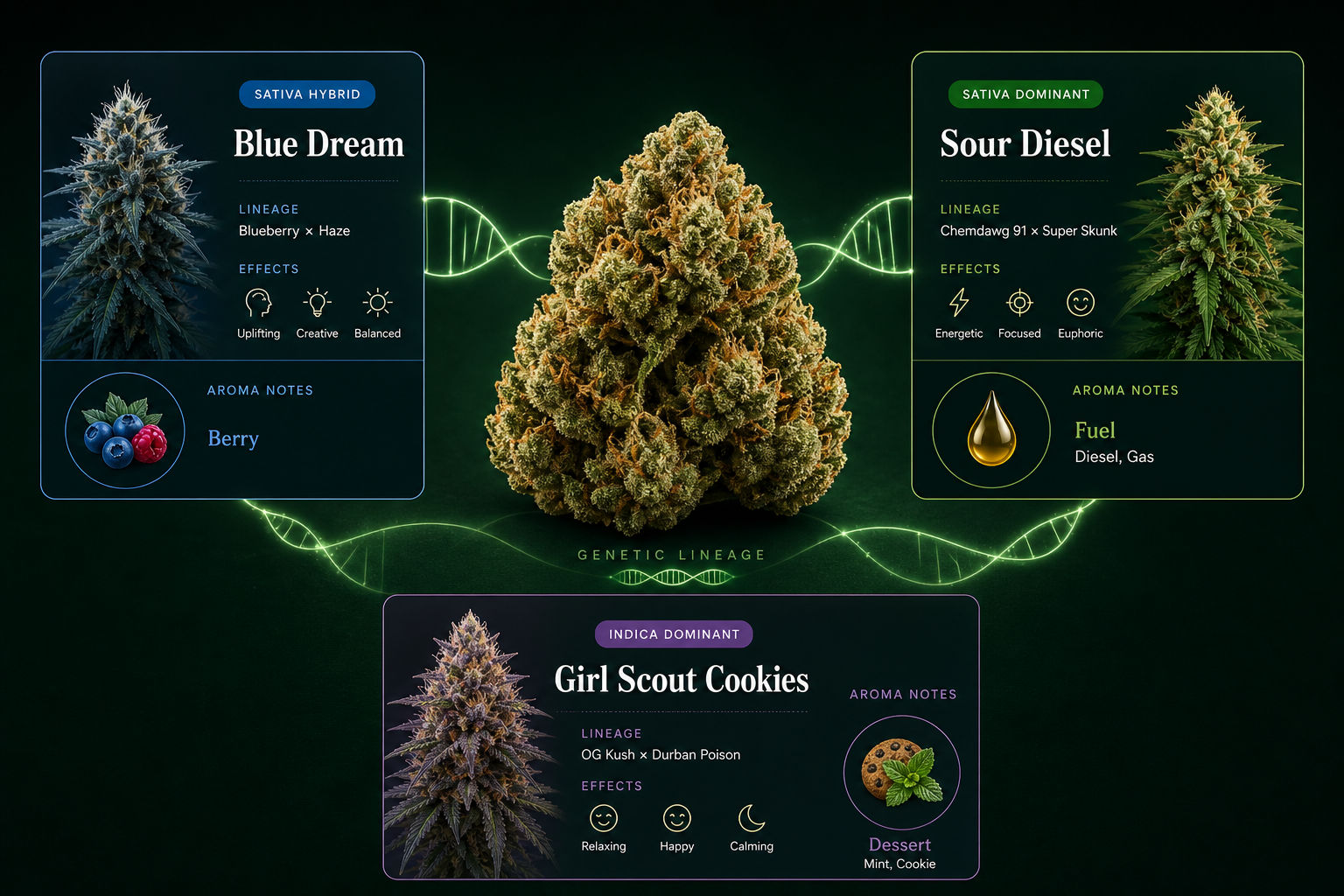
New strain names appear constantly, but a few old favorites refuse to disappear. Blue Dream, Sour Diesel, and Girl Scout Cookies still show up on dispensary menus, strain search pages, seed catalogs, grower conversations, and consumer wish lists because they are more than products. They are reference points.
That is why classic strain names matter even when the modern cannabis market is messy. A shopper who understands the classics can decode menus faster, compare families more intelligently, and avoid treating every catchy label like a guarantee. This guide uses three famous examples to show what strain names can teach you — and where you should ask for lab results, batch details, and fresh eyes instead.
Classic weed strains: the quick version
- Blue Dream: A California-born, berry-leaning hybrid often associated with Blueberry and Haze lineage, broad appeal, and approachable balance.
- Sour Diesel: A fuel-forward East Coast icon tied to Chem/Diesel lore, sharp aroma, and an energetic consumer reputation.
- Girl Scout Cookies / GSC: A Cookies-era breakthrough usually linked to OG Kush and Durban Poison influence, dessert-like aroma, and many famous descendants.
- The reality check: Strain names are cultural shortcuts, not scientific proof. Batch testing, producer quality, storage, freshness, and chemistry still matter.
Why these names still rank
Classic weed strains survive because they are memorable in multiple ways at once. They have clear sensory hooks, strong stories, and enough market presence that consumers can compare notes. Blue Dream became the approachable favorite. Sour Diesel became the loud fuel legend. GSC helped turn dessert-style hybrids into a modern category.
They also became breeding language. When a new hybrid says it has Blue Dream, Diesel, or Cookies influence, the name is doing work: it hints at aroma, structure, expected vibe, and market identity. Sometimes that hint is useful. Sometimes it is mostly branding. The trick is learning to read the signal without worshiping the label.
Blue Dream: the easy-to-like California classic
Blue Dream is commonly described as a cross of Blueberry and Haze, with roots in California medical cannabis culture. The name tells you a lot about why it spread: “Blue” suggests sweet berry aroma, while “Dream” implies smoothness and balance. It is easy to remember, easy to recommend, and broad enough to appeal to people who do not want a strain that sounds extreme.
Visually, Blue Dream-family flower is often sold as bright green, frosty, and medium-to-dense, with orange pistils and a polished commercial look when grown well. Aromatically, the common consumer language is blueberry, sweet fruit, haze, herbs, and sometimes a light pepper or pine edge.
What made Blue Dream powerful culturally was not one single trait. It was the combination: recognizable flavor, high availability, strong yields for growers, and a reputation for being neither too sleepy nor too racy for many consumers. That made it a menu staple — and eventually, for some connoisseurs, almost too common. Popularity can turn a strain into both a favorite and a cliché.
Sour Diesel: fuel, funk, and East Coast attitude
Sour Diesel, often shortened to Sour D, is one of the clearest examples of aroma becoming identity. Before you know its lore, you know its smell: diesel fuel, sour citrus, skunk, chemical sharpness, and earthy funk. That profile helped Sour Diesel stand apart in a market where many strain names sound sweet or fruit-forward.
The lineage is usually discussed around Chemdawg-family genetics and Super Skunk-style influence, with plenty of underground history and disputed details. That uncertainty is normal for classic cannabis. Prohibition-era breeding, clone sharing, regional naming, and informal recordkeeping created legends faster than clean paperwork.
For consumers, Sour Diesel teaches a useful lesson: aroma categories can be more practical than names alone. A jar labeled Sour Diesel should usually have a loud, fuel-forward personality. If it smells flat, grassy, stale, musty, or nothing like the category, the name is not enough to rescue it.
Girl Scout Cookies / GSC: the dessert-strain turning point
Girl Scout Cookies — widely abbreviated as GSC because of trademark concerns around the original name — helped define a different modern lane: dense hybrid flower with dessert-like sweetness, earthy gas, mint, dough, spice, and big bag appeal. It is commonly linked to OG Kush and Durban Poison influence, though exact cuts and descendants vary by source.
GSC matters because it helped launch the Cookies family as a cultural and breeding force. Thin Mint, Platinum Cookies, Gelato, Wedding Cake, Runtz, and many dessert-forward hybrids live in a world that GSC helped popularize. If Blue Dream represents broad dispensary familiarity and Sour Diesel represents fuel nostalgia, GSC represents the bridge into modern hype-strain culture.
The caution is obvious: once a name becomes valuable, it gets stretched. “Cookies” on a label may signal real lineage, a style category, or simple marketing. Look for aroma, structure, resin, freshness, producer reputation, and lab data before assuming the name means the batch will match the legend.
What classic strain names can and cannot tell you
Classic strain names can help you predict a general lane. Blue Dream suggests berry-Haze balance. Sour Diesel suggests sharp fuel and sour funk. GSC suggests dessert, earth, gas, and modern hybrid density. That is useful when comparing menus or learning cannabis families.
But names cannot prove chemistry. Peer-reviewed research has found that cannabis strain names often do not reliably represent consistent chemical or genetic diversity across commercial samples. Another study found that indica/sativa labeling is not a dependable shortcut for chemical composition. The more serious the decision, the more you should prefer batch-specific evidence over folklore.
In practical terms, that means a strain name is a headline, not the full article. The full article includes cannabinoid profile, terpene profile, harvest and package dates, moisture, contaminant testing, grower skill, cure, storage, and your personal tolerance.
How to compare classic strains in real life
- Start with aroma. Blue Dream should usually lean sweet and berry-like; Sour Diesel should be loud and fuel-forward; GSC should suggest dessert, earth, mint, spice, or gas.
- Inspect freshness. Dry, dusty, hay-like flower is a problem even when the strain name is famous.
- Look for mature structure. Visible trichomes, healthy pistils, careful trim, and intact buds matter more than hype.
- Read the label. THC percentage is only one clue. Terpenes, harvest date, test date, and contaminant results give better context.
- Respect dose. A “classic” strain can still be strong. Start low if you are inexperienced or returning after a break.
- Compare batches, not legends. One producer’s Blue Dream may beat another producer’s GSC simply because it was grown, cured, and stored better.
Where photo-based strain identification fits
A clear dry-flower photo can help you study visible clues: bud density, trim style, pistil color, trichome coverage, foxtailing, freshness, and similarity to known examples. That is why visual tools are useful for learning strain families and comparing unknown flower against likely categories.
Still, photo-based identification should stay honest. A picture cannot confirm exact genetics, THC percentage, terpene chemistry, pesticides, heavy metals, microbial safety, or legality. Use KushScan as a visual education and comparison tool, then cross-check with labels, Certificates of Analysis, source reputation, and common sense. For a deeper breakdown, read how to identify a weed strain by picture and cannabis genetics explained.
Compare classic weed strains with KushScan
Take a sharp dry-flower photo and use KushScan to compare visible structure, color, trichome cues, and likely strain-style patterns — without treating a scan as a lab test.
Download KushScanThe takeaway
Blue Dream, Sour Diesel, and GSC still rank because they gave cannabis culture durable shorthand: berry balance, fuel funk, and dessert-hybrid power. Learn those signals, enjoy the history, but judge the flower in front of you. The best cannabis education lives between the story on the label and the evidence in the batch.
Sources
- Leafly: Blue Dream strain overview, used for mainstream strain-culture context, common lineage descriptions, and consumer aroma language.
- Leafly: Sour Diesel strain overview, used for common Sour Diesel descriptions, aroma context, and consumer-facing strain history.
- Leafly: GSC strain overview, used for Cookies-family context and mainstream consumer descriptions.
- Cannabis Chemovar Nomenclature Misrepresents Chemical and Genetic Diversity, peer-reviewed research on limits of strain-name reliability.
- The phytochemical diversity of commercial Cannabis in the United States, peer-reviewed research relevant to chemical diversity and limits of broad label categories.