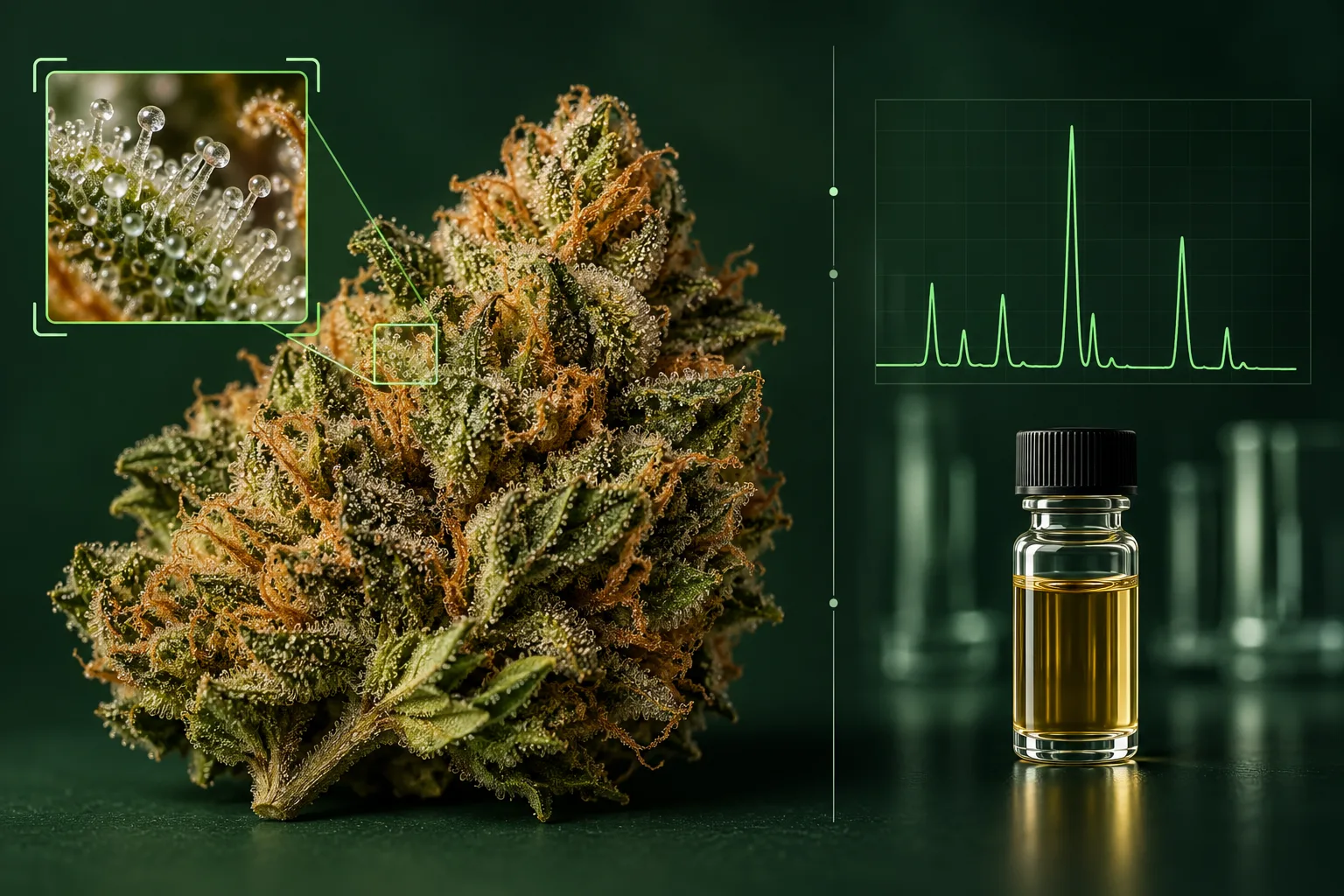
Put two cannabis flowers side by side and many people will pick the frostier one as stronger. Sometimes that guess may happen to match the lab report. It is still a guess. The compounds people mean by “potency” are measured chemically, while a camera records reflected light, shape, color, and surface texture.
That distinction matters for strain-identification tools, shopping decisions, and responsible dosing. Appearance can help describe a sample and flag quality concerns. It cannot turn visible crystals into a trustworthy number.
Can you tell how strong weed is by looking at it? The quick answer
No: you cannot reliably determine cannabis potency from appearance alone. Here is the useful middle ground:
- Visible trichomes matter biologically. Glandular trichomes produce and store cannabinoids and terpenes, so frost is not meaningless.
- More visible frost does not equal a specific THC level. Trichome type, size, maturity, location, chemistry, damage, and camera conditions all complicate the comparison.
- Color and density are not potency meters. Genetics, cultivation, trimming, curing, storage, and lighting can change both.
- A batch-matched laboratory report is stronger evidence. Instrumental methods measure cannabinoids in a prepared sample; a photo does not.
Why frosty weed looks potent
The sparkling coating on cannabis flower comes largely from glandular trichomes. Under magnification, many look like tiny stalks topped with rounded resin heads. These structures are where the plant produces and accumulates much of its cannabinoids and aromatic compounds.
That explains why resin coverage attracts attention. It does not justify a simple “twice the frost means twice the THC” rule. Research reviews note that trichome density is difficult to measure consistently across bracts, sugar leaves, calyxes, and different parts of a flower. Trichomes also vary in morphology, maturity, and cannabinoid concentration—even within a sample.
A normal phone photo adds more uncertainty. Bright side lighting makes resin heads sparkle; flat lighting hides them. Sharpening and contrast can exaggerate texture. Handling may knock mature heads off, while a leafy trim can display many trichomes without representing the chemistry of the whole flower.
For a closer look at these structures, read our guide to cannabis trichomes.
Why dense, purple, or orange flower is not necessarily stronger
Several visual shortcuts sound plausible but fail as potency tests:
- Dense buds: compact structure can reflect genetics and cultivation conditions. It does not establish cannabinoid concentration.
- Purple color: anthocyanin pigments create purple tones. Pigment and THC are different chemistry, and camera white balance can shift the color further.
- Orange hairs: pistils change color as flowers mature and dry, but their color cannot quantify THC.
- Sticky or oily appearance: resin can affect texture, yet a photograph cannot measure stickiness or identify what compounds are present.
- Large buds: size says more about plant growth, position, and trimming than cannabinoid percentage.
These traits can be useful descriptions. They can also help compare flower condition and photography quality. They should not be converted into a potency number or a guarantee of effects. See the weed color guide and bud structure guide for the limits of each clue.
How laboratories actually measure cannabis potency
Laboratories do not grade potency by eye. They prepare a representative portion of material and use analytical instruments—commonly liquid chromatography—to separate and quantify cannabinoids such as THCA, delta-9 THC, CBDA, and CBD.
The National Institute of Standards and Technology supports cannabis laboratories with analytical methods, reference materials, and a quality-assurance program because cannabinoid measurement requires comparability and technical controls. That is a very different process from recognizing surface features in an image.
When a regulated product has a Certificate of Analysis, first confirm that its batch or lot number matches the package. Then check the test date, laboratory, units, THCA and delta-9 THC entries, and the reported total THC. Our guide to reading a cannabis COA walks through the full report.
Even a lab number needs context
A lab result is the best available evidence for measured potency, but it is not a perfect description of every crumb in a package. Cannabis flower is not completely uniform. Sampling, preparation, moisture, analytical method, and laboratory quality practices can affect the reported result. The tested portion must also match the batch in your hand.
“Strong” has a second meaning that no potency percentage can settle by itself: how intense the effects feel. Dose, route of use, tolerance, product chemistry, and individual response all matter. The National Institute on Drug Abuse notes that cannabis effects vary with factors including previous experience, biology, how the drug is taken, and how much is used.
That is why a higher label number is not a personalized effects forecast. Avoid using a visual guess—or one isolated number—as a reason to skip cautious dosing.
What a photo can tell you more responsibly
A clear cannabis photo still contains useful information. It may help you document or compare:
- visible trichome coverage and whether resin heads appear intact;
- bud structure, trim, surface texture, and color distribution;
- pistils, seeds, excess leaf, crushed material, or obvious debris;
- signs of age or poor storage, such as browning and a dry, brittle look;
- possible warning signs that deserve in-person inspection, such as fuzzy growth.
Those are visual observations—not chemical measurements. A photo cannot confirm exact THC, CBD, terpene content, contaminant safety, strain authenticity, or personal effects. Suspicious flower should not be used simply because an image scan looks reassuring.
Can an app estimate THC from a cannabis photo?
An image model can learn associations between visible flower patterns and examples in its training data. That may provide estimated context or help compare visually similar samples. It does not chemically assay the flower, and its estimate should never be presented as equivalent to a batch-specific laboratory result.
Photo quality also changes the evidence available to the model. Neutral light, sharp focus, an intact bud, and a plain background preserve more useful detail. Filters, flash glare, extreme macro crops, and compressed screenshots remove or distort it. Follow our weed photography guide for a more useful scan.
Use KushScan for visual context—not a lab certificate
KushScan compares visible dry-flower traits and can provide estimated context from a photo. Treat the result as one clue, then verify potency with a matching label or COA when that information matters.
Download KushScanThe takeaway
You cannot tell exactly how strong weed is by looking at it. Frosty trichomes have a real connection to cannabinoid production, but visible frost, density, purple color, orange pistils, and bud size do not translate reliably into THC percentage. Photography and processing add still more uncertainty.
Use appearance to describe flower, compare visible traits, and notice condition or safety clues. Use a batch-matched lab report to assess measured potency—and remember that neither a picture nor a percentage can guarantee how a product will affect a particular person.
Sources
- National Institute of Standards and Technology: Tools for Cannabis Laboratory Quality Assurance, overview of analytical methods, reference materials, and laboratory quality programs.
- NIST: Cannabis Laboratory Quality Assurance Program—Cannabinoid Final Report, interlaboratory work covering THC, THCA, total THC, CBD, CBDA, and other measurements.
- Plants: Bracts, Buds, and Biases, peer-reviewed review of trichome-density measurement and its relationship to cannabinoid concentration.
- Frontiers in Plant Science: Cannabis Glandular Trichomes—A Cellular Metabolite Factory, peer-reviewed review of trichome biology and cannabinoid and terpene production.
- National Institute on Drug Abuse: Cannabis (Marijuana), public-health context on THC, dose, routes of use, and variation in effects.