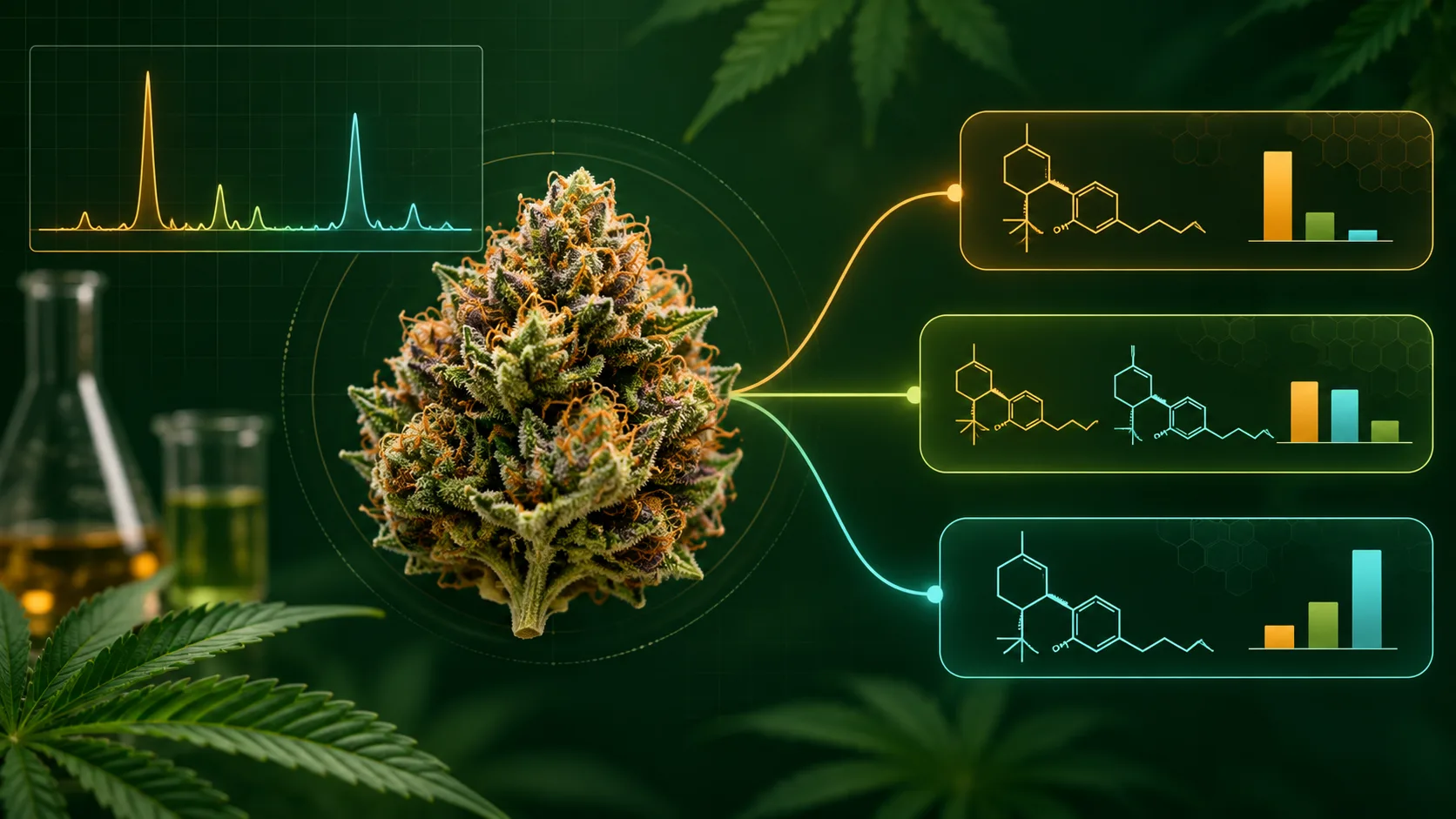
Imagine two jars carrying the same strain name. One laboratory report shows high THC and barely detectable CBD; the other contains a more balanced cannabinoid ratio and a different terpene profile. Now imagine two differently named products whose reports look remarkably similar. Which label gives you the more useful description?
For chemistry, the answer is the laboratory profile. Strain names can carry real breeding history and consumer meaning, but they are not standardized chemical specifications. Cannabis chemotype gives researchers, breeders, labs, and consumers a more objective way to discuss what a plant or flower sample contains.
What is a cannabis chemotype?
A chemotype—short for chemical phenotype—is a category based on the compounds an organism produces. In cannabis, the best-known system uses the relative amounts of the acidic cannabinoid precursors THCA and CBDA, or their corresponding totals after accounting for potential decarboxylation.
The classic three-type framework is simple:
| Chemotype | Dominant pattern | Plain-English description |
|---|---|---|
| Type I | THC-dominant | Much more THCA/THC than CBDA/CBD |
| Type II | Intermediate or balanced | Meaningful amounts of both THC and CBD, often near a balanced ratio |
| Type III | CBD-dominant | Much more CBDA/CBD than THCA/THC |
| Type IV | CBG-dominant | CBGA/CBG is the major cannabinoid pattern |
| Type V | Cannabinoid-poor | Little or no detectable cannabinoid production |
Exact cutoffs vary across papers and regulatory contexts, so the type number should not be treated as a universal potency grade. Type I does not mean “strongest,” and Type III is not automatically legally compliant hemp. Chemotype describes a chemical relationship; legal classifications depend on the jurisdiction, product, sampling method, and applicable THC threshold.
Chemotype vs chemovar vs strain
These terms overlap in everyday cannabis conversation, but they answer different questions.
| Term | Main question | Best evidence |
|---|---|---|
| Strain name | What is this product or lineage called? | Producer records, breeder history, clone or seed provenance, and labeling |
| Cultivar | What cultivated plant selection is being maintained? | Documented breeding, propagation, and plant identity |
| Chemotype | Which broad chemical pattern does the sample express? | Validated analysis of cannabinoids, commonly emphasizing THC:CBD balance |
| Chemovar | How can this variety or product be described by a richer chemical fingerprint? | Reproducible cannabinoid, terpene, and sometimes other metabolite data |
| Phenotype | What observable or measurable traits did this plant express? | Plant observations plus measurements, including morphology and chemistry |
Researchers do not always use chemotype and chemovar in exactly the same way. A useful practical distinction is that chemotype often means a broad cannabinoid class, while chemovar aims to describe a chemically distinct variety with more detail. Neither term guarantees that every package sold under one name will have identical chemistry.
That is why a batch-specific Certificate of Analysis is more informative than relying on a familiar name alone.
Why cannabis strain names do not guarantee chemistry
Commercial names are useful shorthand, but several things can loosen the connection between a name and a chemical profile:
- Different genetics can share a name. Informal naming, renaming, undocumented crosses, and mislabeling can create unrelated products with matching labels.
- Seeds are not clones. Siblings from the same cross inherit different combinations of variants and may express different traits.
- Environment changes expression. Light, temperature, nutrition, harvest timing, drying, and storage can affect the finished batch.
- Testing is batch-specific. Results describe the sampled material, not every past or future harvest carrying that name.
- A single number hides context. Total THC alone does not describe CBD, minor cannabinoids, terpenes, contaminants, or measurement uncertainty.
A large analysis of 89,923 U.S. commercial flower samples found that products labeled indica, hybrid, and sativa did not form clearly distinct chemical groups. Some strain names were more chemically consistent than others, but the authors still found substantial variation. This does not erase cultivar history; it shows why labels and chemistry should be treated as separate evidence layers.
How labs determine cannabis chemotype
Most modern cannabis laboratories use chromatography to separate and quantify compounds in a prepared sample. High-performance liquid chromatography can measure acidic cannabinoids such as THCA and CBDA without first converting them with heat. Gas chromatography can also be used, but its heated inlet changes acidic compounds unless the method accounts for that transformation.
A report may list THCA, THC, CBDA, CBD, CBGA, CBG, and other cannabinoids individually. “Total THC” and “total CBD” commonly estimate the neutral cannabinoid potentially available after decarboxylation. Because the acidic molecule loses carbon dioxide, the usual calculation applies a molecular-weight adjustment:
- Total THC ≈ THC + (THCA × 0.877)
- Total CBD ≈ CBD + (CBDA × 0.877)
Those totals help compare cannabinoid patterns, but the result is only as representative as the sampling and as reliable as the method. NIST’s Cannabis Quality Assurance Program has documented meaningful interlaboratory variability and provides reference materials to help labs evaluate measurements. A chemotype therefore rests on validated chemistry—not packaging art, aroma, visible frost, or a phone photo.
Does a fuller chemical profile predict effects?
A richer profile describes a product more precisely, but description is not destiny. THC dose, CBD content, route of administration, prior exposure, individual sensitivity, medications, setting, and expectations can all influence experience and risk.
Terpenes and minor cannabinoids may help distinguish samples chemically, and researchers continue to investigate how cannabis compounds interact. That does not justify turning a terpene list into a guaranteed mood forecast. Claims such as “limonene always energizes” or “myrcene always sedates” run ahead of the clinical evidence, especially when product dose and individual response are ignored.
Use chemistry to make comparisons more concrete. Do not treat a chemovar label as a personalized medical prediction.
Can a cannabis chemotype be identified from a picture?
No. A picture records reflected light, not cannabinoid concentration. Dense structure, purple pigment, orange stigmas, and heavy-looking trichome coverage are visible traits, but none reveals a THC:CBD ratio.
Even “frost” is an unreliable shortcut. Glandular trichomes are where the plant accumulates many secondary metabolites, yet a normal photograph cannot quantify their contents. Two flowers can look similar and test differently; two visually different flowers can fall within the same broad chemotype.
A bud identifier or photo comparison tool can still help with the visual layer: structure, color distribution, pistils, trim, and resemblance to reference examples. It cannot produce a chemotype, potency result, contaminant screen, or genetic authentication.
A practical way to read cannabis chemistry
- Match the report to the package. Check the producer, product name, batch or lot number, and testing date.
- Read the cannabinoid balance. Compare total THC and total CBD instead of focusing only on the largest number.
- Check minor compounds carefully. CBG, CBC, THCV, and terpene data can add detail when the lab actually measured them.
- Confirm units. Percent by weight and milligrams per gram express the same scale differently: 1% equals 10 mg/g.
- Separate identity from safety. Chemotype describes chemistry; contaminant panels address pesticides, microbes, mycotoxins, heavy metals, solvents, or other required screens.
- Avoid overprecision. Sampling, natural variation, rounding, and laboratory uncertainty mean tiny numerical differences may not be meaningful.
Compare the visible layer
KushScan can compare a clear flower photo with supported visual references. Use the match as an appearance clue, then use the correct batch report when chemistry, potency, or safety matters.
Download KushScanThe takeaway
Cannabis chemotype replaces guesswork with a measured chemical category. Types I, II, and III summarize the THC–CBD relationship; Types IV and V cover less common CBG-dominant and cannabinoid-poor patterns. A fuller chemovar profile can include minor cannabinoids and terpenes, but it still describes a tested sample—not a guaranteed experience. Use names and photos for context, provenance for identity, and validated batch testing for chemistry.
Sources
- Analytical and Bioanalytical Chemistry: Beyond THC and CBD—chemical differentiation of cannabis varieties, research on major and minor cannabinoid profiling.
- PLOS ONE: The Phytochemical Diversity of Commercial Cannabis in the United States, an analysis of 89,923 flower samples, commercial labels, and chemical clusters.
- Frontiers in Plant Science: Identification of Chemotypic Markers in Three Chemotype Categories of Cannabis, research using cannabinoids and other secondary metabolites to distinguish chemotypes.
- NIST: Cannabis Quality Assurance Program, Exercise 1 Final Report, interlaboratory measurement and quality-assurance context.
- Plants: The Cannabis Plant as a Complex System, controlled research on genotype, environment, morphology, and cannabinoid traits.