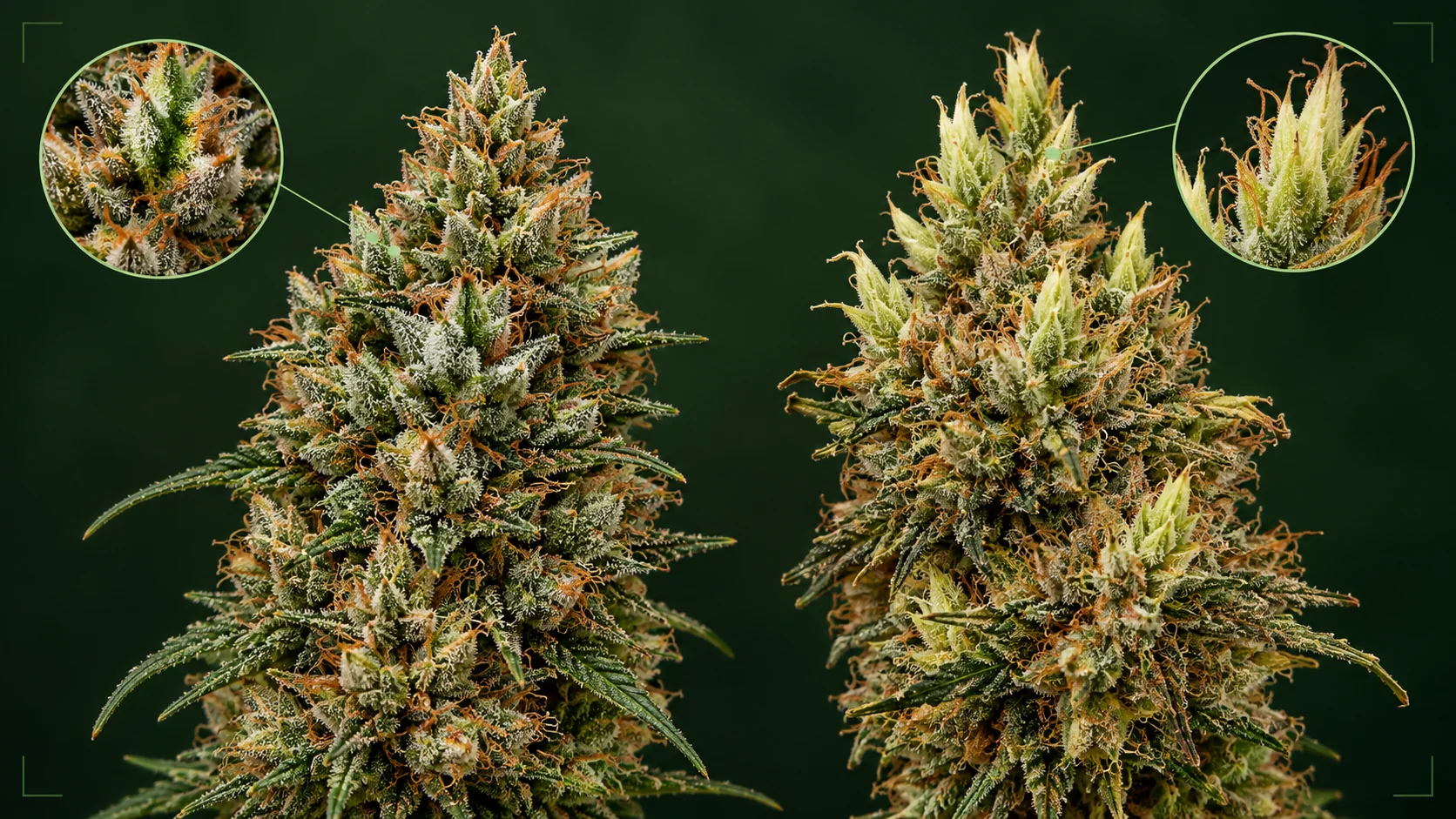
Short answer: foxtails look like pointed towers growing from a cannabis flower. Evenly repeated spires across many buds, without damage, can reflect the plant’s genetics. Sudden, pale, or irregular new growth concentrated near the hottest or brightest part of a canopy can be a warning to inspect the environment. Those are useful clues—not a diagnosis from shape alone.
Foxtailing is not automatically good or bad, and it does not identify a strain. To interpret it responsibly, look beyond one dramatic bud and ask where the pattern appears, when it started, and what else changed.
What is cannabis foxtailing?
“Foxtailing” is informal cultivation language, not a precisely standardized botanical diagnosis. It describes a bud whose flower clusters continue upward in narrow, tapered stacks instead of filling into one rounded or spear-shaped mass.
Growers often call each visible unit a “calyx,” but the leaflike resinous structure visible around a female cannabis flower is more accurately the perigonal bract. Cannabis inflorescences are complex, highly branched structures. Short-day conditions compress their branchlets and internodes, creating the clustered form people recognize as a bud. Genetics and the growing environment both influence that final architecture.
Normal flower swelling can also produce uneven tips. One point on one dried bud is not enough to call a plant foxtailed.
Genetic vs stress-associated foxtailing at a glance
| Clue | More consistent with genetic expression | More consistent with environmental stress |
|---|---|---|
| Distribution | Similar spires across upper and lower flower sites | Concentrated near the canopy top, fixture, hot wall, or another exposure zone |
| Pattern | Repeated, relatively orderly towers integrated into the bud | Patchy or sudden new spires on otherwise mature flower |
| Color | Color and resin coverage broadly match the surrounding flower | Pale or bleached tips and fresh white stigmas may appear near the exposure |
| Other signs | Leaves and flower otherwise look healthy | Leaf-edge curling, dry tips, bleaching, wilting, or stalled growth may appear too |
| History | Trait repeats in the same cultivar under stable conditions | Growth changes after a heat spike, fixture change, or canopy stretch |
These clues are comparative. A cultivar can naturally make pointed flowers and still experience stress; the two categories are not mutually exclusive.
What genetic cannabis foxtailing tends to look like
Plant genotype helps set the range of possible flower forms. Research has documented meaningful genotype-to-genotype differences in cannabis inflorescence morphology and trichome development. In practical terms, some plants repeatedly form looser, elongated, or towered flowers even when the room is stable and nearby plants look healthy.
- It is distributed: the pattern appears at multiple heights and orientations, not only at the brightest top.
- It is consistent: several buds share the same architecture, and the change is not abrupt.
- It is integrated: the pointed stacks look like part of the flower’s overall shape rather than fresh growth erupting from a mature surface.
- It lacks a damage cluster: there is no matching zone of bleached tissue, curled leaves, or scorched tips.
Even this pattern cannot prove a cultivar or lineage. Similar flower architecture can arise in unrelated plants, and cannabis names do not guarantee identical genetics from one producer to another. Our guide to why cannabis strain names are confusing explains why appearance and labels both need context.
What stress-associated foxtailing may look like
Excessive heat and intense light are commonly associated with irregular late-flower growth in cultivation practice. Peer-reviewed cannabis research supports the broader point that environmental stress changes plant physiology, flower development, yield, pigments, and cannabinoid metabolism. However, controlled studies that isolate and measure the specific grower-defined “foxtailing” shape are scarce. That distinction matters: the visual rule is a practical hypothesis, not a laboratory-proven one-to-one test.
Inspect for a cluster of evidence:
- Map the location. Are the affected flowers closest to a lamp, greenhouse hot spot, or poorly ventilated corner?
- Compare the rest of the plant. If shaded and lower buds keep their normal form while exposed tops change, environment becomes a stronger suspect.
- Look for companion symptoms. Pale tops, dry margins, upward-curled leaves, or uneven maturation are more informative together than any single sign.
- Check the timeline. Compare dated photos with temperature, humidity, and lighting records rather than relying on memory.
- Measure at canopy height. A wall thermostat can miss the conditions experienced by the highest flowers.
A photo taken after harvest usually loses most of that evidence. Drying, trimming, compression, handling, and angle can exaggerate points or hide where the bud grew on the plant.
Can a bud photo reveal the cause?
A clear image can show whether the flower has repeated towers, fresh-looking tips, bleaching, leaf curl, or damage. It cannot recover the plant’s environmental history, compare upper and lower canopy conditions, or prove that a genetic trait caused the shape.
For a useful record, photograph the full plant, the affected cola in place, a nearby unaffected flower, and a macro view under neutral light. Include a size reference and save the date with environmental readings. That photo set is much more informative than an isolated “mystery bud” on a table.
If you only have dried flower, treat foxtailing as one feature in a broader bud identification checklist. Compare structure, trichome visibility, pistils, color, trim, and condition. Do not convert a pointed silhouette into a confident strain label.
Does foxtailing mean low-quality cannabis?
No. Appearance alone cannot establish potency, terpene content, contaminants, cure quality, or effects. Naturally towered flower may be resinous and well handled. Stress can reduce yield or create uneven maturation, but the word “foxtailed” does not quantify those changes.
Dense flower is not automatically superior either. Compact buds can hide moisture problems, while airier flowers can be healthy. Quality assessment should combine aroma, moisture and cure, visible contamination checks, source information, and—where available—a batch-matched certificate of analysis. See our guide to reading a cannabis COA for measured potency and safety context.
What foxtailing cannot tell you
- the exact strain, breeder, phenotype, or genetic lineage;
- THC, CBD, CBG, or terpene percentages;
- whether flower is free of pesticides, microbes, or other contaminants;
- how strong the effects will feel to a particular person;
- the precise temperature or light intensity experienced while growing; or
- the correct harvest date from a single still image.
Trichome appearance also needs care. Magnification can help compare clear, cloudy, and amber resin heads on the plant, but lighting and camera processing can shift their apparent color. Read our cannabis trichome guide before treating a macro photo as a maturity meter.
Scan the visible pattern, not the plant’s history
KushScan can compare a clear dry-flower image with examples in its supported strain catalog. Use the result to explore visible similarities such as bud shape, color, pistils, and resin coverage—not to diagnose cultivation stress or authenticate genetics.
Download KushScanThe takeaway
Cannabis foxtailing describes pointed stacks of flower growth, not one proven cause. A uniform pattern across a healthy plant can fit genetic expression. Localized, sudden growth near heat or intense light—especially with bleaching or leaf damage—makes environmental stress worth investigating. Photos are good at preserving the shape; whole-plant comparisons and environmental records are better at explaining it.
Sources
- Frontiers in Plant Science: Architecture and Florogenesis in Female Cannabis sativa Plants, peer-reviewed description of cannabis inflorescence architecture and cultivar differences.
- Horticulture Research: Inflorescence development in female cannabis plants is mediated by photoperiod and gibberellin, peer-reviewed research on condensed flower architecture and photoperiod.
- Journal of Cannabis Research: Effects of short-term environmental stresses on cannabinoid production in young immature flowers, controlled research on severe heat stress and cannabis physiology.
- Frontiers in Plant Science: Glandular trichome development, morphology, and maturation are influenced by plant age and genotype, peer-reviewed comparison of flower morphology, genotype, and trichome development.
- Plants: Morphological Characterization of Cannabis sativa Throughout Its Complete Life Cycle, detailed open-access study of flower and trichome development.