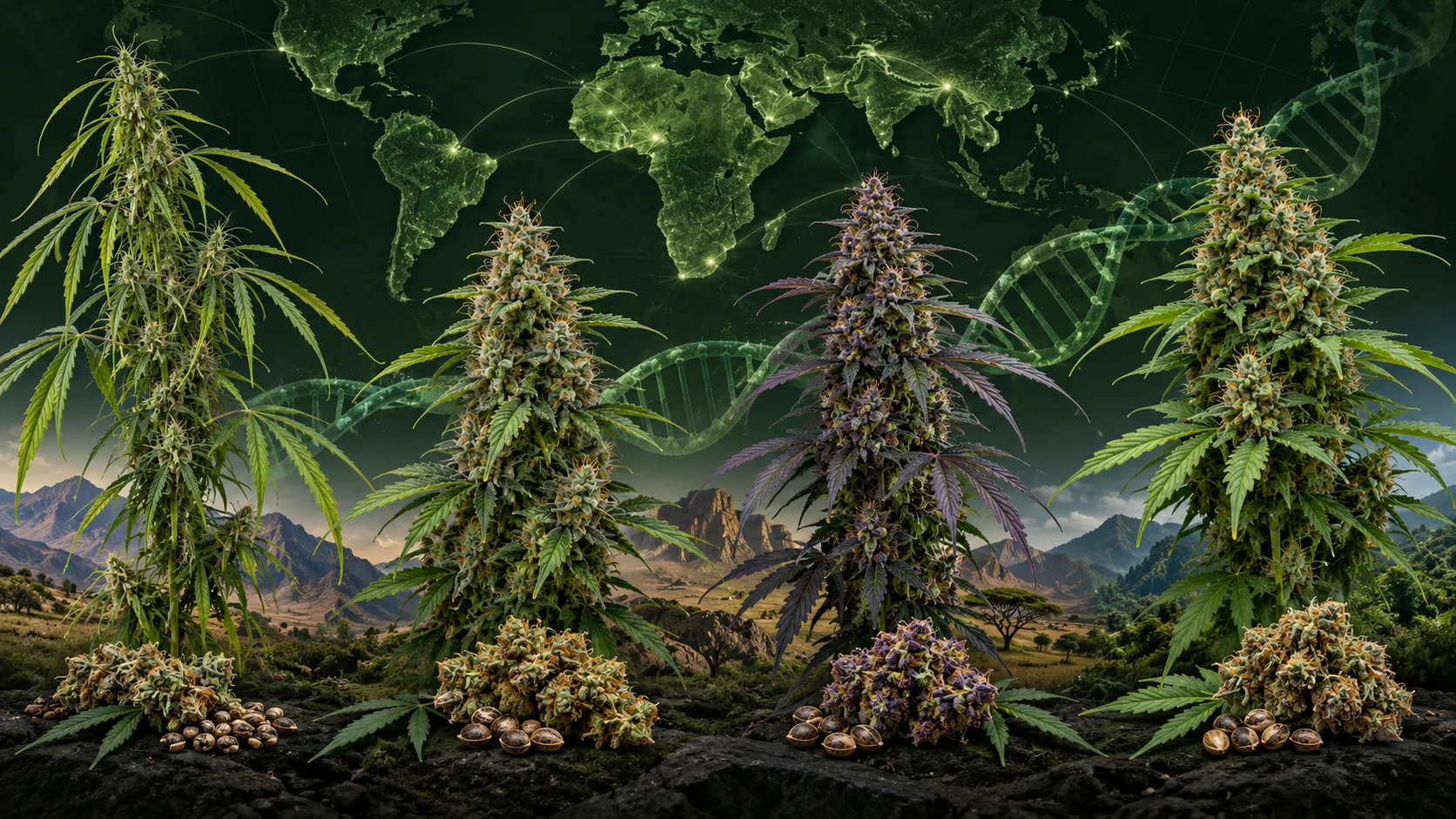
Short answer: a landrace is not simply an old strain from an exotic place. In crop science, the idea usually describes a locally maintained population that developed recognizable traits through long exposure to a region's climate, growing practices, and farmer selection. That history makes landraces valuable to breeders and researchers, but it does not make every seed sold with a geographic name genetically pure or historically verified.
Modern cannabis has moved, hybridized, and been renamed for decades. Understanding landraces therefore requires more than memorizing names such as “Afghani” or “Thai.” It means separating population history from retail labels—and recognizing what photographs, chemistry, and genetics can each tell us.
What are cannabis landrace strains?
A cannabis landrace is best understood as a population, not one perfectly uniform plant. Farmers may save seeds from plants that perform well locally, while weather, day length, elevation, pests, soils, and chance continue to shape the population. Over many generations, plants from the same region can share broad tendencies while still carrying meaningful variation.
That variation is the point. A stable commercial cultivar is often selected for consistency. A traditional landrace population may contain a wider range of flowering times, architecture, aromas, cannabinoid profiles, and stress responses. Researchers can use that diversity to study cannabis history and breeders may draw on it for future crop improvement.
Landrace vs cultivar, heirloom, feral plant, and hybrid
These terms overlap in casual conversation, but they describe different histories:
- Landrace: a traditional population associated with long-term local adaptation and cultivation in a region.
- Cultivar: a cultivated variety maintained because people value particular traits. Many modern named “strains” are better discussed as cultivars, although cannabis naming is often inconsistent.
- Heirloom: usually a landrace-derived line preserved outside its original region. The term is informal and does not guarantee documented provenance.
- Feral cannabis: plants descended from cultivated cannabis that now reproduce without deliberate cultivation. Feral does not automatically mean wild or ancestral.
- Modern hybrid: offspring produced by crossing selected lines or cultivars. Hybrids may combine ancestry from several geographic populations.
The boundaries are not always tidy. Pollen travels, seeds move with people, and populations interbreed. A name can survive even when the underlying population has changed.
How geography can shape cannabis populations
Regional environments can favor different combinations of traits. Day length and season length influence flowering; temperature, humidity, elevation, water availability, and local cultivation goals can influence which plants leave seed. Human selection matters alongside natural selection: growers historically selected cannabis for fiber, seed, resin, ritual use, medicine, or combinations of those purposes.
Broadly, plants adapted to long tropical seasons may develop differently from populations grown where autumn arrives quickly. But this is not a reliable visual passport. Environment changes plant form, growers select within populations, and recent hybridization can blur old regional patterns.
What genetics says about cannabis origins
A 2021 whole-genome study of 110 cannabis accessions found evidence consistent with early domestication in East Asia and later divergence of hemp-type and drug-type groups. The study included feral plants, landraces, historical cultivars, and modern hybrids, and it emphasized that truly wild progenitors may no longer survive.
Other genomic work also finds population structure related to domestication, end use, and geography. Yet no single study samples every surviving population, and cannabis history is unusually difficult to reconstruct after millennia of movement, selection, prohibition, and undocumented breeding. Scientific findings should refine the story—not be turned into a simplistic claim that every modern strain belongs to one pure ancient category.
Why cannabis landrace genetics matter
- Genetic diversity: traditional populations can preserve alleles missing from a narrow set of commercial lines.
- Local adaptation: breeders may study traits connected with flowering time, climate response, disease resistance, plant architecture, or resource use.
- Research context: well-documented accessions help scientists investigate domestication and the relationships among hemp, drug-type cannabis, and feral populations.
- Cultural history: landraces reflect generations of knowledge and selection by farming communities, not just genetics in isolation.
Preservation is not as simple as putting seeds in a jar. Useful conservation depends on accurate collection records, enough plants to represent population diversity, careful regeneration, and protection against unintended cross-pollination.
Can you identify a landrace cannabis strain by picture?
No photo can verify that a plant or bud is a genuine landrace. Images can show architecture, leaf proportions, flower density, color, trichomes, and condition. Those features may support a comparison, but they cannot establish where seed was collected, how many generations it was maintained locally, whether it crossed with introduced plants, or whether the label has a documented chain of custody.
Cured flower provides even less geographic context than a whole living plant. Trimming, drying, storage, lighting, and camera processing can make unrelated samples look similar. Our guide to plant identifiers versus bud identifiers explains why each image type contains different evidence.
For meaningful verification, researchers may combine:
- Provenance: collection location, date, grower history, and seed-handling records.
- Population sampling: multiple plants rather than one attractive specimen.
- Genetic analysis: comparison with documented reference accessions and related populations.
- Phenotype and chemistry: repeated observations grown under controlled or well-recorded conditions.
Common landrace myths
“Landrace means genetically pure”
Traditional populations are dynamic. Gene flow, seed exchange, selection, and drift can occur without turning history into a simple purity test. Documented continuity and population context are more useful concepts.
“Landrace means stronger or better”
Landrace status does not guarantee potency, flavor, yield, safety, or a particular effect. Those are separate questions, and measured chemistry belongs on a batch-matched certificate of analysis.
“A geographic name proves origin”
A name is a clue, not evidence. Commercial labels can persist after outcrossing or be applied because they sound familiar. This is one reason cannabis strain names can be confusing.
“All modern strains fit cleanly into indica or sativa”
Recent hybridization has blurred many of the distinctions attached to those retail categories. Historic regional populations may show meaningful differences, but modern “indica” and “sativa” labels should not be treated as genetic certificates or dependable effect predictions.
Use visual matching as a starting point
KushScan compares a clear dry-flower photo with examples in its supported strain catalog. Use the result to explore visible similarities—not to certify landrace origin, genetics, geography, or laboratory chemistry.
Download KushScanThe takeaway
Cannabis landrace strains are regionally adapted, historically cultivated populations with valuable genetic and cultural context. Their importance comes from diversity and documented history, not a promise of purity or superiority. Photos can reveal useful visual traits, but credible landrace claims need provenance, representative sampling, and genetic research.
Sources
- Science Advances: Large-scale whole-genome resequencing unravels the domestication history of Cannabis sativa, genomic analysis of domestication and population structure.
- G3: Genome-wide polymorphism and genic selection in feral and domesticated lineages of Cannabis sativa, research on genomic variation, feralization, and local adaptation.
- Plants: A classification of endangered high-THC cannabis domesticates and their wild relatives, peer-reviewed discussion of regional domesticates, hybridization, and conservation.
- Journal of Experimental Botany: Same, yet different—towards understanding nutrient use in hemp- and drug-type cannabis, review connecting domestication history, geographic expansion, and local adaptation.