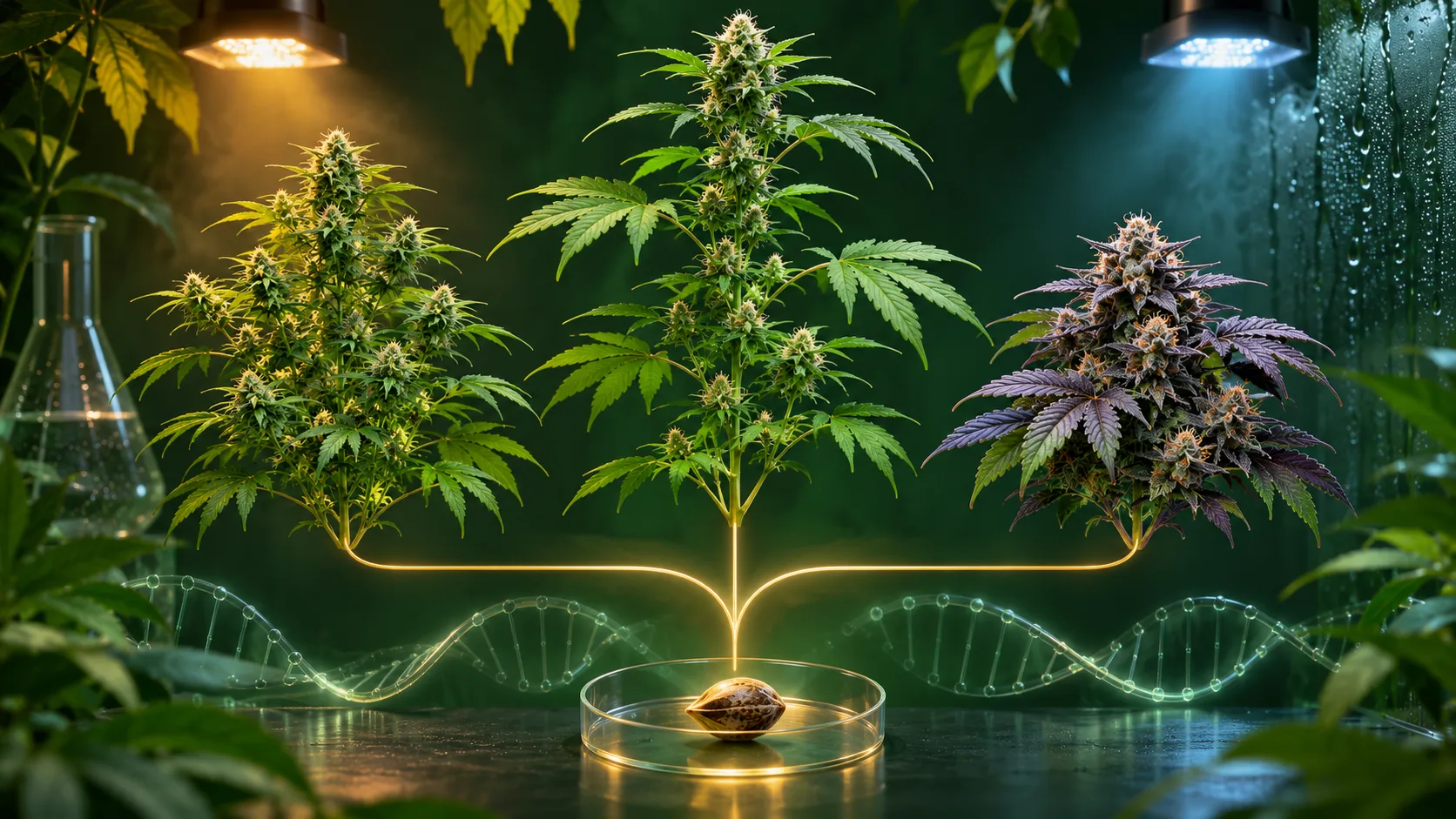
Open a pack of cannabis seeds and the plants may behave like siblings: recognizably related, but not identical. One may stretch higher, another may branch more tightly, and a third may develop darker flowers or a different aroma. Grow cuttings from one mother plant and the genetics are much more consistent, yet the harvested buds can still differ between rooms, harvests, or growers.
That is not a contradiction. It is the normal relationship between genotype, phenotype, and environment. Understanding it makes strain names, phenotype hunts, clone-only cultivars, lab results, and photo-based identification much easier to interpret.
Cannabis phenotype vs genotype in plain English
| Term | What it means | Cannabis examples | How it is checked |
|---|---|---|---|
| Genotype | The inherited genetic makeup of a plant | Alleles affecting cannabinoid synthesis, flowering behavior, pigment potential, or growth form | Breeding records and DNA-based tests |
| Phenotype | The observable or measurable traits produced by genotype interacting with environment | Height, branching, leaf form, flower structure, color, aroma, yield, and measured chemistry | Observation, measurement, and laboratory analysis |
| Chemotype | A plant or product category based on chemical composition | THC-dominant, balanced THC:CBD, CBD-dominant, or other chemistry-led groupings | Validated laboratory testing |
A useful shortcut is phenotype = genotype + environment + their interaction. It is not a literal equation and does not mean every trait is influenced equally by both sides. Some characteristics are strongly inherited; others respond more noticeably to light, temperature, nutrition, stress, harvest timing, drying, and storage.
Why seeds from the same cross are not identical
When breeders cross two genetically varied cannabis parents, each seed receives a newly shuffled combination of inherited variants. The resulting plants are siblings, not copies. Even when every seed packet carries the same cross name, individual plants can express different combinations of:
- plant height, internode spacing, and branching;
- leaflet width and growth speed;
- flowering time and flower structure;
- pigmentation and visible resin coverage;
- aromatic character and measured chemical composition;
- yield, stress response, and susceptibility to disease.
A breeder’s phenotype hunt is the process of growing a population, comparing those expressions, and selecting plants that best fit the goal. The “keeper” might be preserved as a mother plant and reproduced through cuttings. Selection can favor aroma, structure, maturation time, chemistry, disease resistance, or a combination—not simply the most photogenic flower.
Are cannabis clones genetically and visually identical?
A cutting is intended to preserve the donor plant’s genotype, which makes clonal propagation useful for maintaining a selected cultivar. But matching genotype does not guarantee matching finished flower. Two cuttings placed in different conditions can express different phenotypes.
Light intensity and spectrum, temperature, root-zone conditions, water availability, nutrients, pests, plant training, harvest timing, and post-harvest handling can all influence what reaches the jar. A controlled study of diverse cannabis genotypes found that flower morphology was especially responsive to cultivation environment, while several cannabinoid traits showed higher heritability. Overall cannabinoid concentration could still vary with environmental conditions.
So “same clone” and “same batch” are not interchangeable. Clone provenance supports genetic continuity; a batch-specific Certificate of Analysis describes the tested sample’s measured chemistry and safety screens.
Where chemotype fits
Chemotype focuses on chemical phenotype rather than plant shape or a commercial name. A simple cannabinoid classification might group samples as THC-dominant, balanced THC:CBD, or CBD-dominant. More detailed chemical profiles can include minor cannabinoids and terpenes.
Genes play a major role in cannabinoid biosynthesis, but inheritance is more complicated than a single “THC gene.” Research on cannabis crosses has found both additive and non-additive genetic contributions to cannabinoid concentration. Meanwhile, a large analysis of 89,923 commercial flower samples found that familiar “indica,” “hybrid,” and “sativa” labels did not reliably separate products by chemistry. Products sharing a strain name varied too, although some names were more chemically consistent than others.
This is why a chemotype is not something to guess from purple color, dense buds, narrow leaves, or visible trichomes. Those are visual phenotypes. Chemistry requires appropriate laboratory measurement.
Can you see genotype in a cannabis photo?
You can see phenotypic clues, not the complete genotype. A photo may show flower shape, bract arrangement, pistils, pigmentation, trim, and visible trichome coverage. Those traits can support a comparison with known examples, but many genetic routes and growing environments can create overlapping appearances.
A dry flower image also leaves out much of the plant’s life history. It usually cannot show mature plant height, branching habit, flowering time, root behavior, aroma, or batch chemistry. Drying, trimming, storage, lighting, camera processing, and compression add another layer of variation.
Peer-reviewed genetic research illustrates the naming problem. In one study, 6 of 17 same-name comparisons were genetically closer to samples carrying different names than to samples carrying the same name. That does not mean every cultivar label is meaningless. It means a name or visual resemblance should not be treated as DNA authentication.
What this means for a weed strain identifier
A weed strain identifier compares visible phenotype. It can look for similarity in flower structure, color distribution, pistil patterns, trim, and visible resin. It cannot read the genome, reconstruct breeding records, smell the sample, or replace a lab test.
Use a photo match as one evidence layer:
- Start with a clear image. Photograph one dry flower in neutral light with sharp focus and minimal background clutter.
- Compare several traits. Overall structure matters more than one dramatic feature such as purple color or heavy frost.
- Check provenance. Packaging, producer, batch number, seed or clone source, and cultivation records add context a photo cannot contain.
- Use batch-level chemistry. Read the matching lab report when cannabinoid, terpene, or contaminant information matters.
- Keep the conclusion probabilistic. “Visually compatible with” is more defensible than “genetically proven.”
Common phenotype and genotype mix-ups
- “A phenotype is a strain.” Not exactly. A phenotype is the expressed traits of an individual. A selected individual may later become a named clone or breeding parent.
- “Two plants from the same seed pack have the same genotype.” They share parents, but ordinary seeds contain recombined genetic combinations.
- “Clones always produce identical buds.” Clones preserve a genotype, while cultivation and post-harvest conditions influence expression and final appearance.
- “Purple flower proves purple genetics.” Genetic capacity matters, but temperature, development, nutrition, and processing can affect visible pigmentation.
- “A genotype tells you the exact THC percentage.” Genetics constrain potential, but an exact batch result comes from representative sampling and validated analysis.
- “A strain name proves genotype.” Names can preserve useful history, yet inconsistent sourcing, seed variation, renaming, and labeling errors weaken certainty.
Where KushScan fits
KushScan helps compare the visible layer: the phenotype captured by a camera. A strong photo can reveal whether an unknown flower resembles supported reference examples and can make visual traits easier to discuss. The result is a plausible match, not a genotype test, potency estimate, or safety certificate.
Compare visible cannabis traits
Use a sharp, neutrally lit photo of one dry flower and let KushScan compare structure, color, pistils, trim, and visible trichomes—while keeping genetics and chemistry as separate questions.
Download KushScanThe takeaway
Genotype describes inherited instructions. Phenotype describes the traits those instructions produce in real conditions. Chemotype narrows the focus to measurable chemistry. Together, these ideas explain why seed siblings vary, why clones can finish differently, and why flower photos are useful but limited evidence. When identity matters, combine visual comparison with provenance; when chemistry or safety matters, use batch-specific laboratory data.
Sources
- Plants: The Cannabis Plant as a Complex System, a controlled study of relationships among genotype, morphology, physiology, flowering, and cannabinoid traits.
- Cannabis and Cannabinoid Research: Cannabinoid Inheritance Relies on Complex Genetic Architecture, research on additive and non-additive contributions to cannabinoid inheritance.
- PLOS ONE: The Phytochemical Diversity of Commercial Cannabis in the United States, analysis of 89,923 flower samples, chemotypes, commercial categories, and strain-name consistency.
- PLOS ONE: The Genetic Structure of Marijuana and Hemp, genotyping research on ancestry labels, commercial names, and genetic identity.
- NIH NCCIH: Cannabis (Marijuana) and Cannabinoids—What You Need To Know, federal consumer context on cannabis products, evidence, and safety.