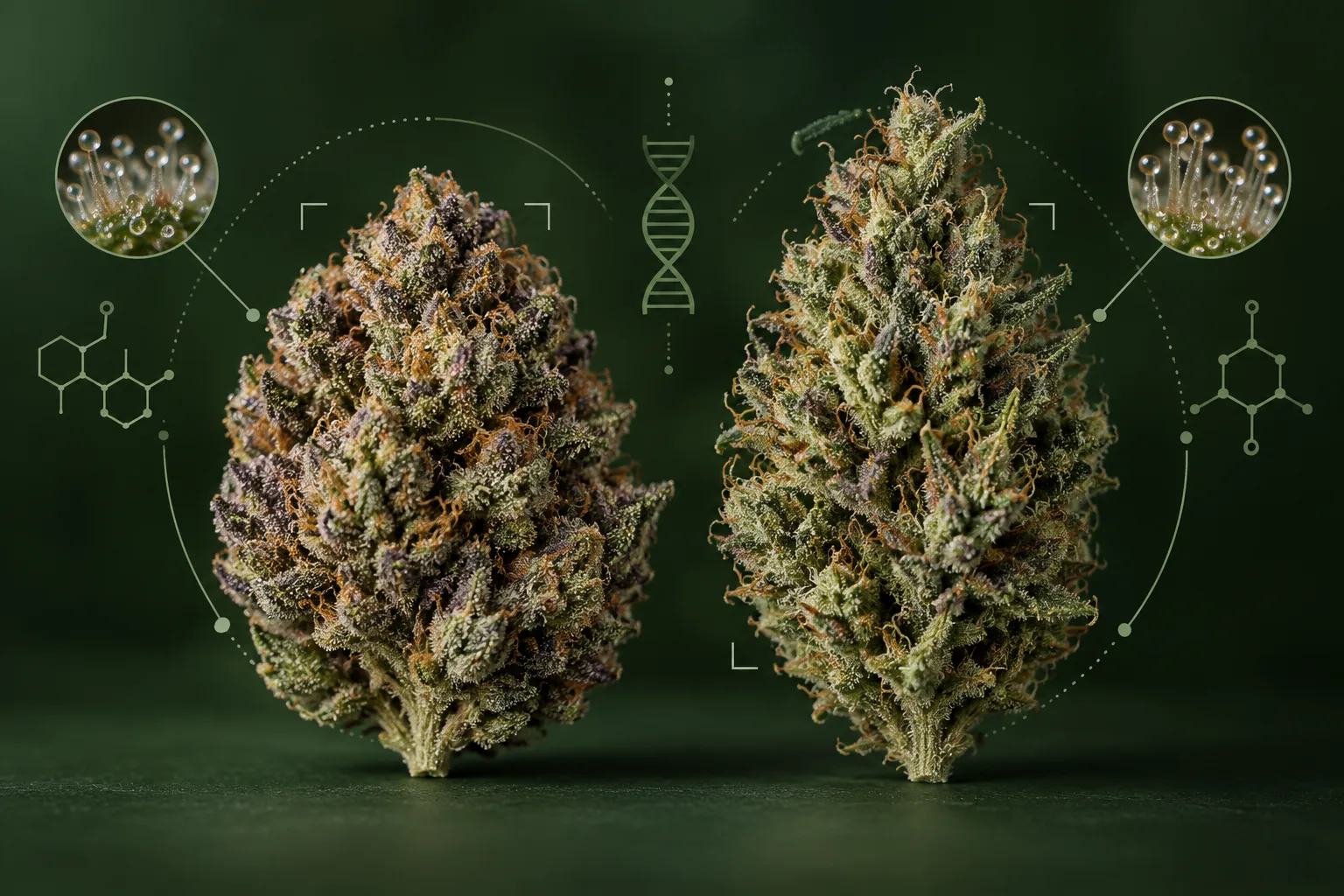
One nug looks compact and dark. Another looks long, loose, and bright green. It is tempting to call the first indica and the second sativa. That shortcut feels tidy, but modern cannabis is not tidy. Breeding, hybrid ancestry, cultivation, trimming, curing, storage, and even camera lighting can all change the look of flower.
The useful answer is not that appearance means nothing. Plant structure and flower shape contain real information. The problem is that consumers usually see only a processed bud, while the old indica/sativa visual descriptions came largely from differences in whole plants and broad ancestral populations. Here is what those cues can—and cannot—tell you.
Indica vs sativa appearance: the quick answer
You cannot reliably identify modern commercial cannabis as indica or sativa from a photo of dried flower alone.
- Whole living plants offer more clues: height, branching, internode spacing, leaflet width, and flowering pattern can describe growth form.
- Dried buds offer weaker clues: density, elongation, color, pistils, and trim can suggest a visual type, but the categories overlap.
- Appearance does not predict chemistry: a compact bud does not establish THC, CBD, terpene content, or likely effects.
- Better evidence exists: cultivar provenance, a batch-matched Certificate of Analysis, cannabinoid and terpene results, and a trusted producer provide more context.
A photo-based tool can compare visible traits and propose similarities. It should not turn a rounded or airy shape into certainty about ancestry or effects.
Where the classic visual differences came from
Historical and botanical descriptions often distinguish narrow-leaf drug types from broad-leaf drug types. In simplified consumer language, “sativa” became associated with taller plants, narrower leaflets, longer spacing between branches, and later flowering. “Indica” became associated with shorter, more compact plants, broader leaflets, denser branching, and earlier maturation.
Those descriptions refer primarily to an entire plant growing over time—not one trimmed flower in a bag. They also sit beside a complicated taxonomic debate. Formal botanical names, regional populations, breeder terminology, and retail labels do not always use “sativa” and “indica” in the same way.
Research on wide- and narrow-leaflet breeding populations confirms that cannabis can have measurable morphological differences. Other genetic work, however, shows that traits people assume travel together—such as leaf shape, plant architecture, and cannabinoid chemistry—may separate after lineages are crossed. Modern hybrid breeding makes a simple two-box visual system especially unreliable.
What people look for in dried cannabis flower
When only the harvested bud is visible, people commonly use a few informal cues:
- Dense versus airy structure: compact, rounded buds are often called indica-like; elongated or open buds are often called sativa-like.
- Bud shape: blunt clusters may be read as broad-leaf ancestry, while tapered or spear-shaped flowers may be read as narrow-leaf ancestry.
- Color: dark green or purple is sometimes marketed as indica, while lighter green is sometimes marketed as sativa.
- Pistils and trichomes: orange hairs and heavy frost are regularly pulled into guesses even though both occur across many unrelated cultivars.
These features can describe the sample in front of you. They are poor category tests. A grower can produce denser flower through light intensity, environment, plant training, harvest choices, and genetics that do not match the retail label. Trimming can hide small leaves and reshape the outline. Drying and storage can shrink, flatten, brown, or break the flower.
Even color is slippery. Genetics influence pigmentation, but temperature, nutrition, maturity, oxidation, white balance, and editing affect what the camera records. See our weed color guide for a closer look at those variables.
Why modern hybrids blur the picture
Commercial cannabis has been crossed and selected for generations. A plant can inherit a growth trait from one ancestor, aroma chemistry from another, and a cannabinoid profile that does not match either parent’s retail reputation.
A 2021 genomics study found that samples labeled sativa and indica were genetically indistinct across the genome overall. The labels did show associations with variation in some terpene synthase genes and certain aromas, but that is not the same as two clean genetic groups. The researchers also found that samples sharing a cultivar name could be genetically and chemically distant.
A separate analysis of nearly 90,000 commercial flower samples found that indica, hybrid, and sativa labels did not reliably separate products by cannabinoid and terpene chemistry. Chemically defined groups performed better than the familiar retail categories.
This is why a bud can look “indica” while carrying a sativa label, or why two packages labeled with the same category can smell and feel different. For more background, read why cannabis strain names are so confusing.
Can leaf shape identify indica or sativa?
Leaf shape is a more relevant clue than dried-bud shape, but it still needs context. Broad versus narrow leaflets can help describe living plants and breeding populations. It does not automatically reveal the flower’s chemical profile, and a single detached leaf is not proof of a retail category.
Studies of hybrid populations have found that commonly paired traits can lose their association after crossing. A plant may have broad leaflets without the cannabinoid or growth characteristics people expect from an “indica.” Photography adds another problem: perspective, plant age, leaf position, and stress can all change the apparent width or shape.
If you have only dry flower, leaf-based identification becomes weaker still because large fan leaves are removed before sale and small sugar leaves are often closely trimmed.
Why appearance cannot predict effects
The biggest mistake is turning a visual guess into an effects claim: dense equals sleepy, airy equals energetic. A photo does not reveal dose, cannabinoid concentration, terpene profile, minor compounds, tolerance, product freshness, or how a particular person will respond.
The large commercial chemistry study found substantial overlap among indica, hybrid, and sativa labeling. That makes the categories a weak foundation for predicting systematic effects. Product chemistry is not the whole experience either, but it is more directly measurable than shape.
When shopping in a regulated market, compare the batch label and Certificate of Analysis. Look at THC and CBD values in context, note the tested terpenes when available, start cautiously, and avoid assuming a category guarantees a response. Labels may be useful shorthand for a retailer’s intended positioning; they are not a personalized promise.
What a cannabis photo can identify more responsibly
A clear flower image can still be useful. Instead of forcing it into an indica/sativa box, use it to document visible features:
- overall bud shape and density;
- green, purple, orange, or brown color patterns;
- pistil color and distribution;
- visible trichome coverage and surface texture;
- trim style, broken material, seeds, or excess leaf;
- possible quality warnings such as fuzzy growth or unusual residue.
Those observations help compare samples and narrow possibilities. They cannot authenticate genetics, measure potency, confirm contaminant safety, or guarantee freshness. Our guide to identifying a weed strain by picture explains how to combine images with packaging, aroma, source history, and testing.
How to take a more useful identification photo
- Use neutral, indirect light. Warm lamps and flash distort green, orange, and purple tones.
- Photograph one intact bud. Ground flower loses much of the structure a visual comparison needs.
- Keep the full shape visible. Add one close-up for trichomes, but do not make an extreme macro your only image.
- Choose a plain background. Avoid fingers, bags, jars, and patterned surfaces competing with the flower.
- Skip filters and portrait blur. Artificial sharpening, saturation, and background effects can invent or erase useful details.
Good photography improves the quality of the visible evidence. It does not remove the biological overlap between categories.
Compare visible flower traits with KushScan
KushScan analyzes dry cannabis photos for visual similarities in shape, color, pistils, trichomes, and surface texture. Treat the result as a comparison clue, then check labels, source history, and lab data for stronger context.
Download KushScanThe takeaway
Classic indica vs sativa appearance descriptions are most meaningful at the whole-plant level, where height, branching, leaf width, and flowering form can be observed together. A trimmed dry bud preserves only part of that information. Modern hybrid ancestry, inconsistent labels, cultivation, processing, and photography create too much overlap for a flower photo to prove indica or sativa identity.
Describe what the image actually shows, use photo scanning as a comparison tool, and rely on batch-specific chemistry and trustworthy provenance when the distinction matters.
Sources
- Nature Plants / PMC: Cannabis labelling is associated with genetic variation in terpene synthase genes, genome and chemistry research on sativa- and indica-labeled samples.
- PLOS ONE / PMC: The phytochemical diversity of commercial Cannabis in the United States, analysis of 89,923 commercial flower samples and the limits of indica/hybrid/sativa labels.
- PLOS ONE: The Genetic Structure of Marijuana and Hemp, genetic analysis of reported ancestry and strain-name identity.
- Plants / PMC: Analysis of Morphological Traits in Wide and Narrow Leaflet Medical Cannabis, research on plant morphology, chemotype, and breeding populations.
- Frontiers in Plant Science / PMC: Widely assumed phenotypic associations in Cannabis sativa lack a shared genetic basis, evidence that morphology and chemistry can separate in hybrid ancestry.
- National Institute on Drug Abuse: Cannabis (Marijuana), public-health context on THC, cannabis products, and individual effects.