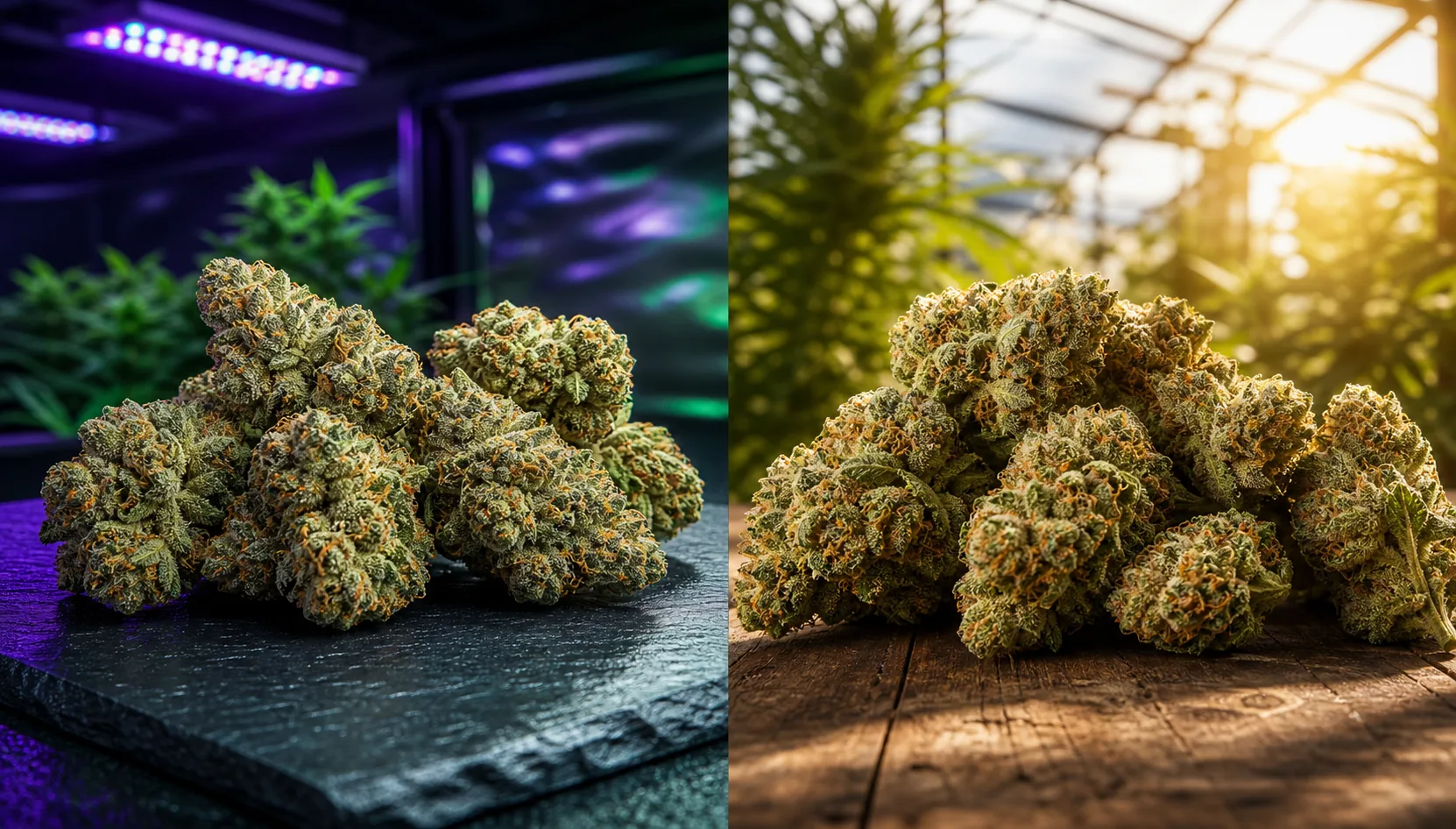
If you have ever compared a glossy dispensary nug with a looser sun-grown flower, you have already seen part of the indoor vs outdoor weed conversation. Indoor cannabis often gets praised for dense structure and visual consistency. Outdoor cannabis often gets praised for natural sunlight, scale, and a broader farm-grown character. Greenhouse flower sits somewhere in the middle.
The useful question is not “which one wins?” It is: what can growing style realistically tell you before you buy, scan, or consume a batch?
Indoor vs outdoor weed: the quick difference
- Indoor weed is grown in controlled rooms with artificial light, managed temperature, humidity, airflow, irrigation, and nutrients.
- Outdoor weed is grown under natural sunlight and weather, usually with more seasonal variation and less total environmental control.
- Greenhouse weed uses sunlight plus structural protection and sometimes supplemental lighting, blackout curtains, climate systems, or automated irrigation.
All three can produce excellent cannabis. All three can also produce mediocre flower if the plant is stressed, harvested too early, dried too fast, stored poorly, or mislabeled.
Why indoor flower often looks denser and more polished
Indoor cultivation gives growers tight control. They can tune light intensity, day length, temperature, humidity, airflow, plant spacing, nutrients, and pest prevention. That control can create the compact, frosty, camera-friendly flower many consumers associate with premium dispensary weed.
Indoor rooms also protect buds from rain, wind, dust, and many outdoor stressors. That can mean cleaner-looking trim, more uniform color, and fewer weather marks. For photo-based tools like KushScan, that consistency can make some visual patterns easier to compare — but it can also make different indoor-grown hybrids look surprisingly similar.
Why outdoor weed can have more natural variation
Outdoor cannabis lives in a bigger environment. Sunlight changes through the season. Nights cool down. Wind strengthens stems. Soil biology, elevation, humidity, pests, smoke exposure, and harvest weather can all influence the final flower.
That variation is not automatically bad. Some sun-grown flower has excellent aroma, color, and resin. A 2023 study comparing genetically identical commercial cannabis grown indoors and outdoors found meaningful differences in cannabinoid and terpene profiles, including more sesquiterpenes in outdoor samples for the cultivars studied. The takeaway is not that outdoor is always chemically superior; it is that environment can influence plant chemistry in real, measurable ways.
Light changes more than the vibe
Light is one of the biggest differences between indoor and outdoor cultivation. Outdoor plants receive broad-spectrum sunlight. Indoor plants receive a designed spectrum from LEDs, HPS lamps, or other fixtures. Research reviews suggest that light spectrum can affect cannabinoid and terpene accumulation, and that UV, blue, red, and full-spectrum strategies may influence plant secondary metabolites differently.
For consumers, keep this simple: lighting can shape the plant, but it does not replace genetics or testing. A beautiful LED-grown bud is not automatically high-THC. A sun-grown bud is not automatically terpene-rich. Batch-specific lab results are still the best way to understand cannabinoids and terpene numbers.
What you can see in a cannabis photo
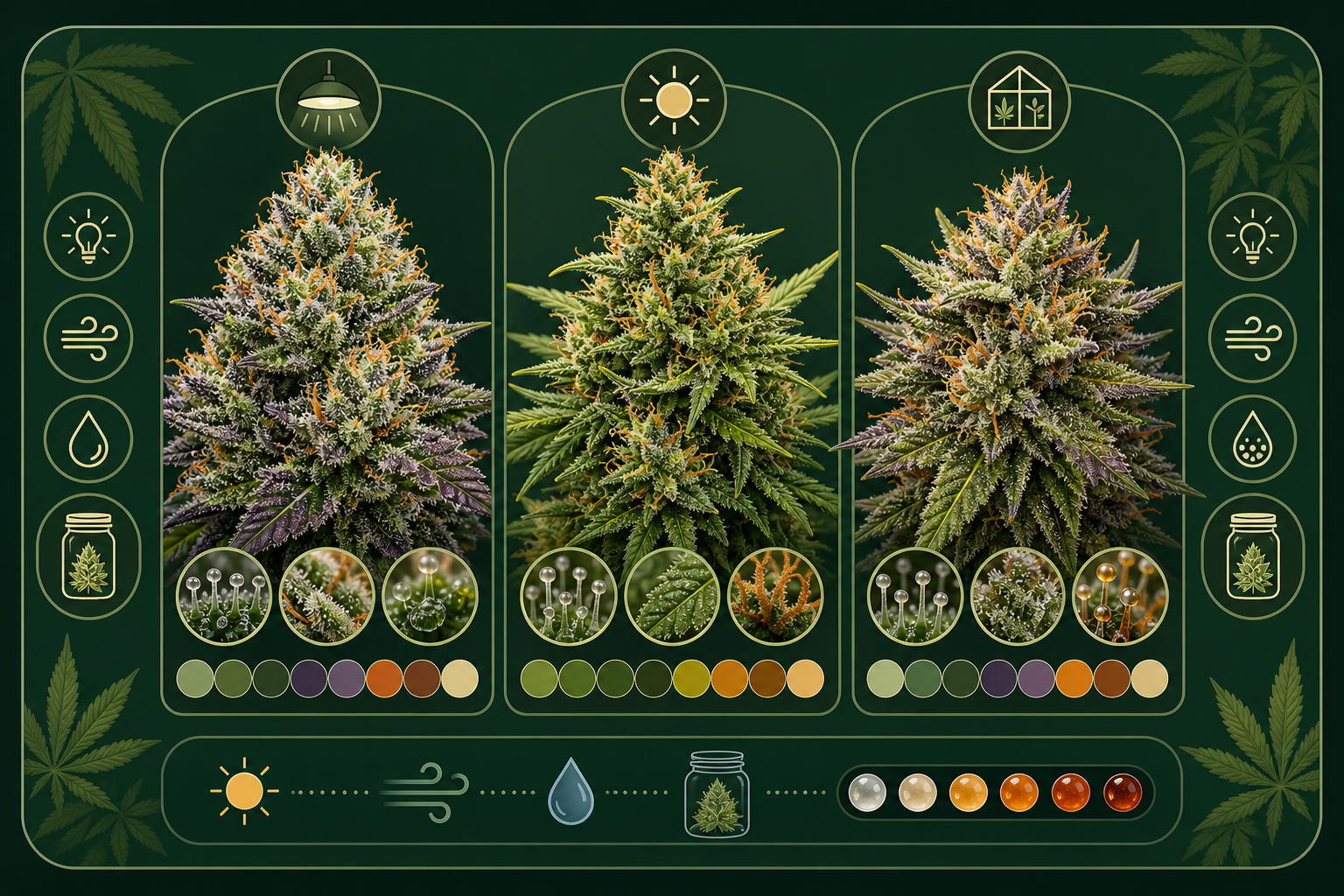
A clear dry-flower photo can reveal useful clues, especially when you compare indoor vs outdoor weed:
- Bud structure: indoor flower often appears tighter and more uniform; outdoor flower may look larger, looser, or more varied.
- Trim and handling: rough trim, shake, flattened buds, or excessive leaf can suggest post-harvest handling issues.
- Color: purple, lime, olive, orange pistils, and darker tones can be visible, but color alone does not prove potency or strain identity.
- Trichome visibility: frosty surfaces are a good sign of resin coverage, but photos cannot measure THC or terpene percentages.
- Freshness cues: overly brown, dusty, brittle-looking, or dull flower may deserve extra caution.
That is why KushScan treats visual identification as a clue, not a lab report. Photos help with comparison. Labels, certificates of analysis, and responsible dosing complete the picture.
What a photo cannot prove
Even a perfect macro photo cannot tell you whether a batch passed contaminant testing. It cannot verify pesticide results, microbial safety, heavy metals, water activity, exact THC, terpene percentages, or whether the strain name is genetically accurate. Those facts come from regulated testing and trustworthy supply chains.
This matters especially with outdoor flower, where weather and environment can introduce more visible variation, and with indoor flower, where polished appearance can create a false sense of certainty. Good-looking weed still deserves good documentation.
Indoor vs outdoor weed for effects
Growing style may influence chemistry, but effects are personal. Dose, THC level, CBD content, terpene mix, tolerance, route of use, setting, sleep, food, medications, and individual biology all matter. The same strain grown two ways can feel different, but the label “indoor” or “outdoor” is too broad to predict your experience by itself.
If you are newer to cannabis or trying a stronger batch, start low and go slow. Treat high-THC flower with respect, regardless of how it was grown.
How to choose between indoor, outdoor, and greenhouse flower
Use growing style as one useful filter, not the whole decision:
- Choose indoor when you value visual consistency, tight trim, controlled production, and polished bag appeal.
- Choose outdoor when you value sun-grown cultivation, seasonal character, larger-format flower, or brands focused on regenerative and farm-style production.
- Choose greenhouse when you want a middle path: sunlight plus more control than an open field.
- Check the COA when potency, terpene profile, or safety results matter.
- Check freshness because bad drying or storage can ruin flower from any grow style.
How KushScan fits into the comparison
If you are comparing flower visually, take a clear photo in bright indirect light with no filter. Fill the frame with one dry bud, keep it sharp, and avoid colored LEDs that distort the flower. Then use KushScan as a visual learning layer alongside packaging and lab information.
For more practical scanning context, see our guides to identifying a weed strain by picture and taking better weed photos for cannabis strain identification.
Scan indoor vs outdoor weed with KushScan
KushScan helps compare dry cannabis flower photos against visual strain patterns, structure, color, and trichome cues — while keeping the limits of photo-based identification clear.
Download KushScanThe takeaway
Indoor vs outdoor weed is a useful lens, not a final verdict. Indoor growing can produce polished, consistent flower. Outdoor growing can produce expressive sun-grown cannabis with real environmental character. Greenhouse cultivation can blend both worlds. The smartest approach is to combine what you can see, what the label says, what the COA proves, and how your own body responds.
Sources
- PubMed: Comparison of the Cannabinoid and Terpene Profiles in Commercial Cannabis from Natural and Artificial Cultivation, 2023 study comparing genetically identical commercial cannabis grown indoors and outdoors.
- Frontiers in Plant Science: Cannabinoids and Terpenes: How Production of Photo-Protectants Can Be Manipulated to Enhance Cannabis sativa L. Phytochemistry, review of lighting spectrum and cannabis secondary metabolites.
- NIH NCCIH: Cannabis, Marijuana, and Cannabinoids — What You Need To Know, consumer health context for cannabis, cannabinoids, and safety cautions.
- FDA: What You Need to Know About Cannabis and Cannabis-Derived Products, Including CBD, regulatory and consumer-safety context for cannabis-derived products.