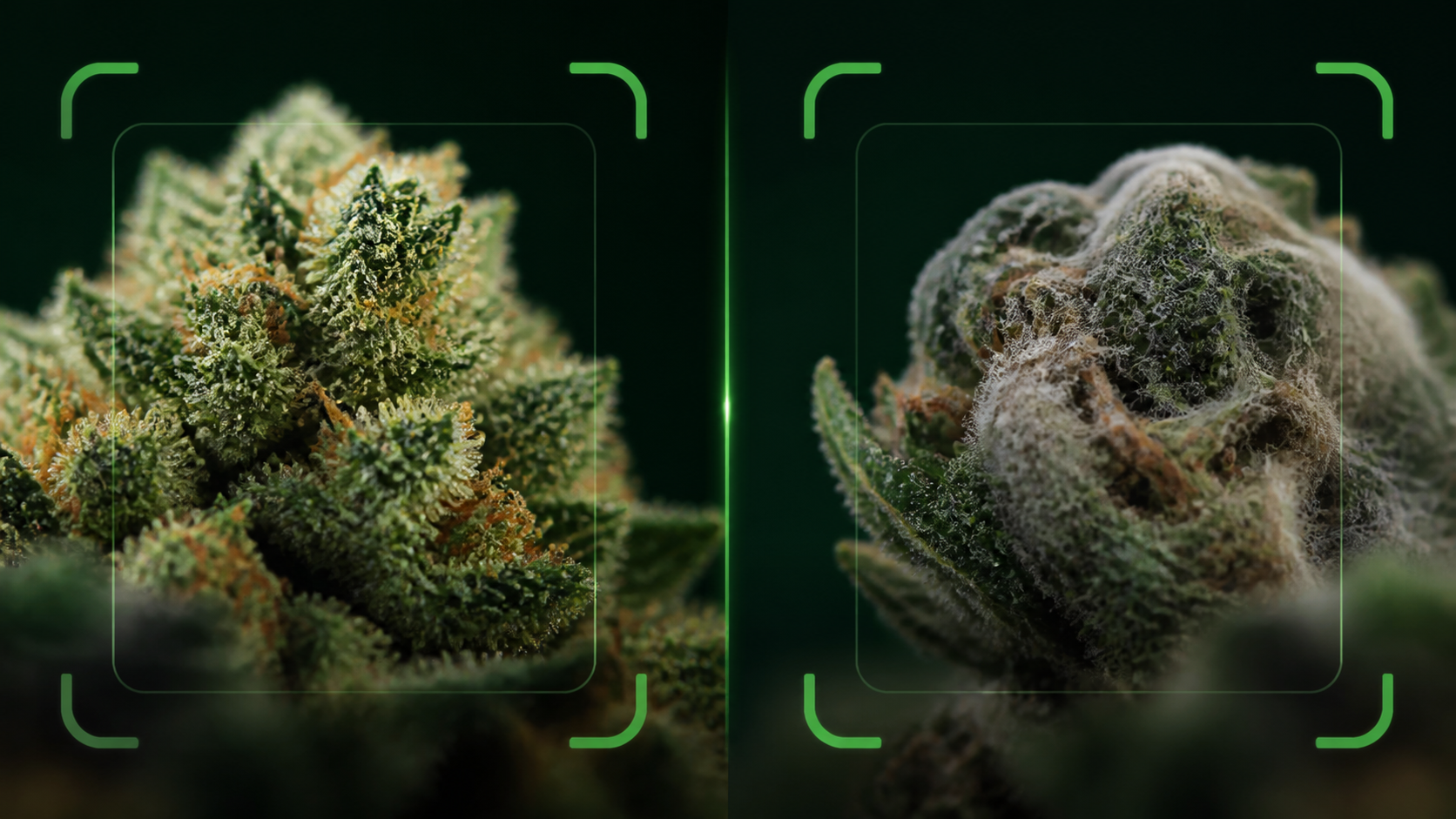
If you search for “moldy weed pictures,” “white fuzz on weed,” or “is this mold or trichomes,” you are probably trying to make a quick judgment before using a product. That is understandable. Cannabis flower is a natural plant product, and visual inspection is often the first thing consumers have.
The key is to be cautious. Trichomes are normal resin structures associated with cannabinoids and terpenes. Mold is unwanted fungal growth. Some contamination can be hard to see, and even a sharp photo cannot replace regulated testing, a valid Certificate of Analysis, or common-sense safety judgment.
Moldy weed vs trichomes: the quick visual check
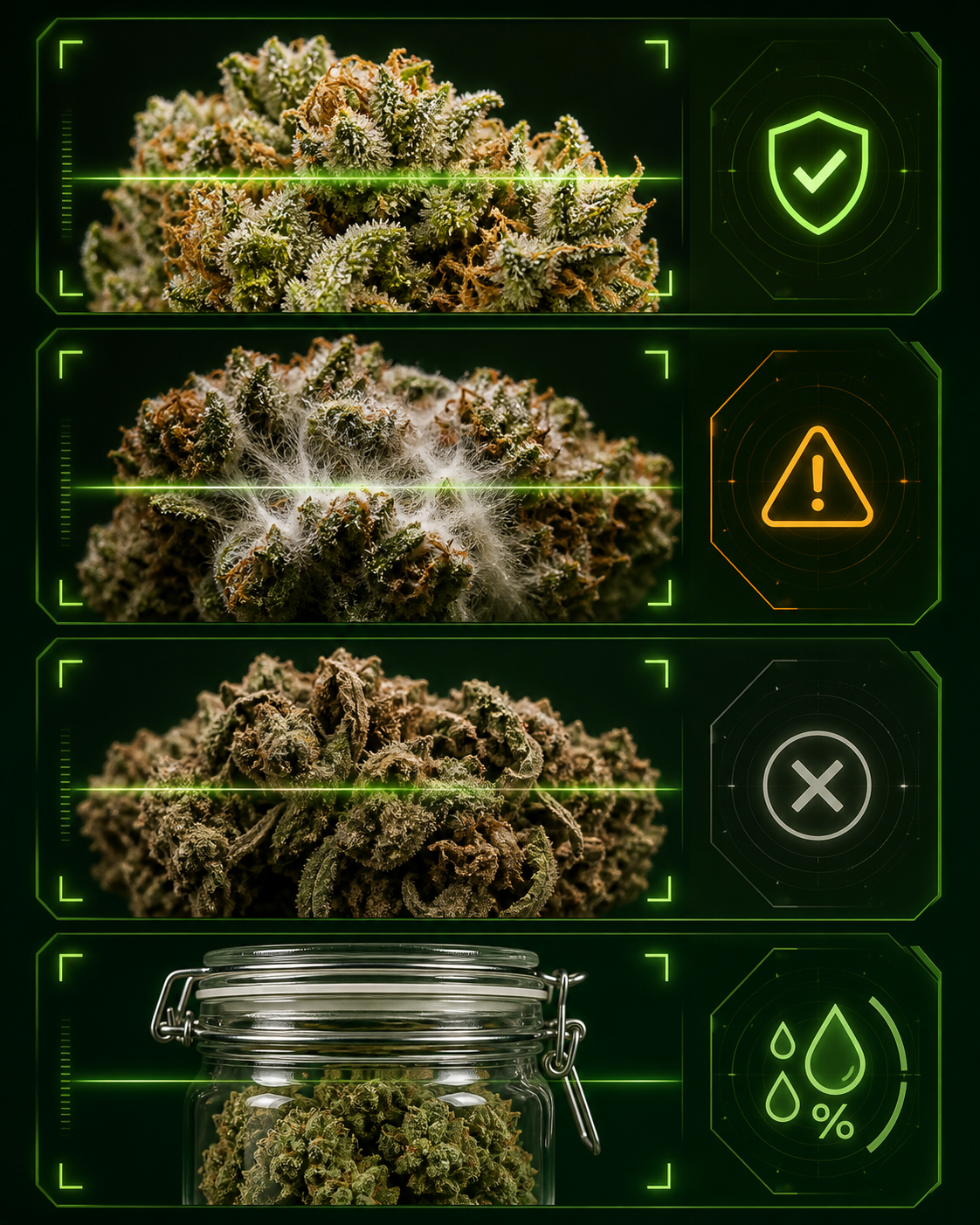
Start with the surface texture. Trichomes usually look like tiny crystals, sugar, frost, or sand sprinkled across the bud. Mold is more likely to look fuzzy, powdery, webby, gray, cottony, or unevenly smeared over one area.
- Trichomes: sparkle under light, appear granular or crystalline, follow the bud surface, and are often densest on flower bracts.
- Mold: may look like fuzz, cobwebs, powder, gray-white patches, dusty clumps, or growth tucked inside dense flower.
- Old or poorly stored weed: can look dull, brown, brittle, flat, or dusty without obvious active fuzz.
- Smell clue: musty, basement-like, sour, wet-hay, or mildew odors are warning signs, even if the photo looks ambiguous.
When in doubt, do not try to “scan your way” into confidence. A weed scanner can help inspect visible features, but it should not be treated as a mold safety clearance.
What healthy trichome frost looks like
Healthy cannabis frost comes from glandular trichomes — tiny resin-producing structures on the flower surface. Scientific reviews describe cannabis trichomes as important sites for cannabinoid and terpene production and storage. To the eye or camera, heavy trichome coverage can look white, silver, sandy, sparkly, or glassy.
Good trichome frost usually has a consistent “crystal dusting” across the flower rather than a strange patch sitting on top. Under bright neutral light, it should catch highlights. In a macro photo, individual resin heads may look like small dots or beads. In a normal phone photo, they may blend into a frosty layer.
That frost does not automatically prove high THC. Resin coverage is a useful quality clue, but potency still needs lab context. For a deeper breakdown, read cannabis trichomes explained.
What moldy weed may look like in pictures
Mold does not always announce itself clearly. CDC mold guidance notes that mold can appear as spots in different colors and may smell musty. On cannabis, consumers often notice suspicious gray-white fuzz, powdery patches, thread-like webbing, unusual dark spots, or material that looks like it is growing across the plant surface instead of being part of the resin texture.
Dense buds can make this harder. Mold may hide inside the flower, near the stem, or in compact pockets where moisture was trapped during drying, curing, packaging, or storage. A single exterior photo can miss that. Breaking flower open for inspection may reveal musty smell, gray interior material, or webby texture — but if you are already suspicious, the safer decision is not to use it.
Why mold risk is not just cosmetic
Cannabis and hemp flowers can host many fungi. A peer-reviewed review in Applied Microbiology and Biotechnology describes more than 100 fungal species associated with the cannabis mycobiome and highlights fungi of concern such as Aspergillus, Penicillium, Fusarium, and Mucor. Some are relevant because of potential opportunistic infections or mycotoxins, especially for vulnerable people.
This does not mean every ugly-looking bud is dangerous or every nice-looking bud is safe. It means visual confidence has limits. People with compromised immune systems, lung conditions, or other medical concerns should be especially careful and should follow professional medical advice rather than relying on cannabis photos.
Photo clues that make identification harder
A lot of “mold or trichomes?” confusion comes from bad photography. Flash can turn trichomes into harsh white glare. Warm kitchen lighting can make old flower look healthier than it is. Purple grow lights can hide gray or brown tones. Heavy image sharpening can make resin look like powder.
If you want a more honest photo for visual review or KushScan:
- Use neutral light. Soft daylight or a clean white lamp is better than colored LEDs.
- Use a plain background. Avoid patterned tables that make fuzzy edges hard to see.
- Take one whole-bud shot and one close shot. Structure and surface detail both matter.
- Do not add filters. Saturation and sharpening can hide warning signs.
- Check multiple angles. Mold is often patchy; one flattering side can miss the problem.
These habits also improve general weed photos for cannabis strain identification.
What to do if your weed looks suspicious
If flower looks fuzzy, smells musty, feels damp, has gray powdery patches, or makes you hesitate, the practical answer is simple: do not use it. Do not assume scraping off a visible patch solves the problem. Do not rely on smoking heat as a safety fix. Do not use an app result, strain name, or pretty packaging to override obvious quality concerns.
For regulated products, check the package date, batch number, testing information, and any available COA. A good COA can include contaminant testing, not just THC percentage. Our guide to reading a cannabis COA explains how to match a lab report to the product in your hand.
Can KushScan identify moldy weed?
KushScan is designed to analyze dry cannabis flower photos for visual strain-style clues and context. It can help you look more carefully at color, bud structure, trichomes, and surface texture. That makes it useful for learning and comparison.
But mold safety is a different claim. A photo-based tool should not be treated as a lab test, medical device, or contamination certificate. If a scan says a flower visually resembles a known strain, that does not mean the flower is clean, safe, fresh, or free of fungal contamination. Use visual tools as a second set of eyes, not as permission to ignore red flags.
Use photo scanning for clues, not safety guarantees
KushScan can help inspect dry flower photos for visual strain cues, but suspicious mold, musty smell, damp texture, or contamination concerns should always win over an app result.
Download KushScanThe takeaway
The simplest moldy weed vs trichomes rule is texture plus caution. Trichomes tend to look crystalline, sparkly, and evenly attached to the flower. Mold tends to look fuzzy, powdery, webby, gray, patchy, or musty. Photos can help you notice those clues, but they cannot prove safety. If cannabis looks or smells wrong, skip it and verify quality through trusted sources and testing.
Sources
- Fungal and mycotoxin contaminants in cannabis and hemp flowers, peer-reviewed review of fungal contaminants, health implications, testing, and risk management.
- Cannabis Glandular Trichomes: A Cellular Metabolite Factory, peer-reviewed review of trichomes and cannabinoid/terpene production.
- CDC: About Mold, general public-health guidance on mold appearance, musty odor, and moisture conditions.
- FDA: Products Containing Cannabis or Cannabis-Derived Compounds, consumer context on product quality, unsafe manufacturing, and unproven claims.
- NCCIH: Cannabis, Marijuana, and Cannabinoids — What You Need To Know, NIH overview of cannabis and cannabinoids.