Some strain names come and go. OG Kush stayed. It shows up in dispensary menus, seed catalogs, rap lyrics, breeding projects, and consumer conversations because it became shorthand for a certain kind of cannabis experience: loud aroma, heavy reputation, and genetics that seem to echo through half the modern hybrid shelf.
That popularity also makes OG Kush confusing. Ask five growers about its origin and you may hear five versions. Look at five products labeled OG Kush and they may not look, smell, or test exactly alike. The useful question is not “can we prove the one true OG from a label?” It is “what made OG Kush important, and what clues can a consumer realistically read?”
OG Kush explained: the quick version
- Category: Usually described as a hybrid, often with dense Kush-family influence and a strong West Coast identity.
- Origin story: Common lore places OG Kush’s rise in the 1990s, moving from Florida stories into Los Angeles cannabis culture.
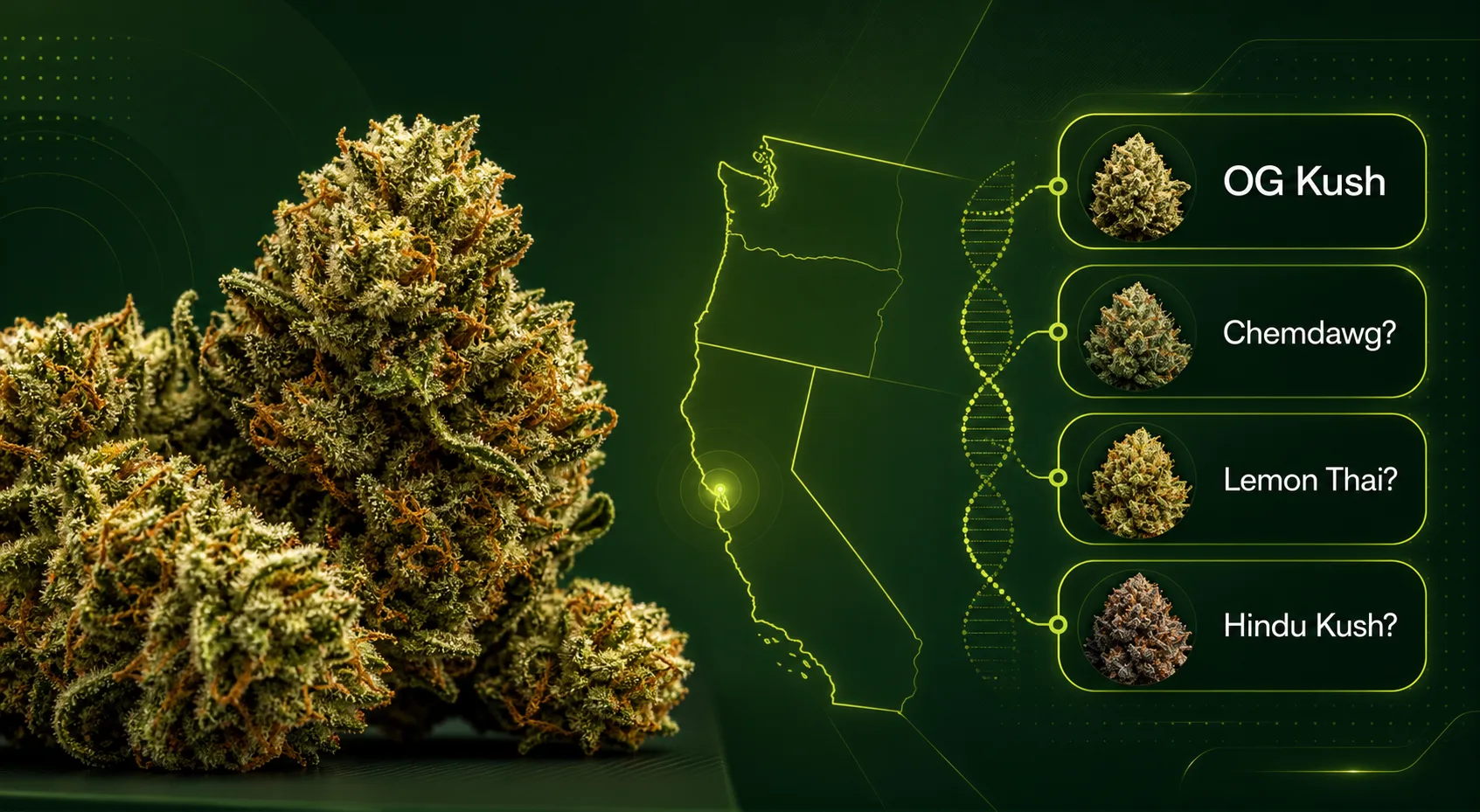
- Lineage: Frequently linked to Chemdawg, Lemon Thai, and Hindu Kush-related genetics, but the exact parentage is disputed.
- Aroma: Famous for pine, lemon, earth, pepper, and fuel/diesel-style notes.
- Legacy: OG Kush influenced many later “OG,” “Kush,” Cookies-era, and fuel-forward hybrids.
- Reality check: The name alone cannot prove genetics, potency, safety, or effects. Labels, COAs, source, appearance, and aroma all matter.
Why OG Kush became famous
OG Kush arrived at the right cultural moment. In the 1990s and 2000s, high-quality indoor flower, California cannabis culture, clone-only cuts, and strain-name storytelling started shaping what many consumers considered “top shelf.” OG Kush fit that era perfectly: it was pungent, memorable, hard to ignore, and easy to turn into a legend.
Its appeal was not only potency. Lots of cannabis can be strong. OG Kush stood out because it had a recognizable personality: sharp citrus, pine, earthy spice, and fuel-like funk. That aroma profile made it easy for people to talk about, compare, chase, and breed from.
Once a strain becomes a reference point, it becomes bigger than a product. “OG” started appearing as a family marker — Tahoe OG, SFV OG, Larry OG, Ghost OG, Fire OG, and many more. Some are close relatives, some are selected cuts, and some are branding decisions. Either way, OG Kush became part of the vocabulary.
The origin story: useful lore, not court evidence
The most repeated OG Kush origin stories involve Florida growers, a move to California, and later popularity in Los Angeles. Some accounts connect the name to “Original Gangster,” others to “Ocean Grown,” and still others treat “OG” as a marker of authenticity rather than a literal acronym. Cannabis prohibition, clone sharing, underground breeding, and loose recordkeeping all helped blur the paper trail.
That does not mean the history is worthless. Culture matters in cannabis. Origin stories explain how a name gained power, why certain aromas became fashionable, and how a cultivar family spread through growers and consumers. But it is smarter to treat OG Kush history as well-supported folklore with disputed details, not a perfectly audited botanical certificate.
What are OG Kush genetics?
OG Kush is often described as involving Chemdawg, Lemon Thai, and Hindu Kush-related genetics. That combination makes intuitive sense: Chemdawg-like fuel, Thai-influenced brightness, and Kush-family density and resin are all part of the way people describe OG Kush. But “often described” is doing important work here.
Modern cannabis strain names are not regulated like scientific cultivar registrations in most consumer markets. Peer-reviewed research has found that strain names can exaggerate chemical diversity, and that samples sold under the same name can show genetic inconsistency. In other words, “OG Kush” may be useful shorthand, but it is not a guarantee that every batch shares the exact same genome or chemical profile.
For beginners, the cleanest mental model is this: OG Kush is a famous strain family and cultural reference point. A specific batch should still be judged by its producer, label, Certificate of Analysis when available, flower quality, aroma, and your own tolerance — not by the name alone.
OG Kush aroma: pine, fuel, citrus, earth
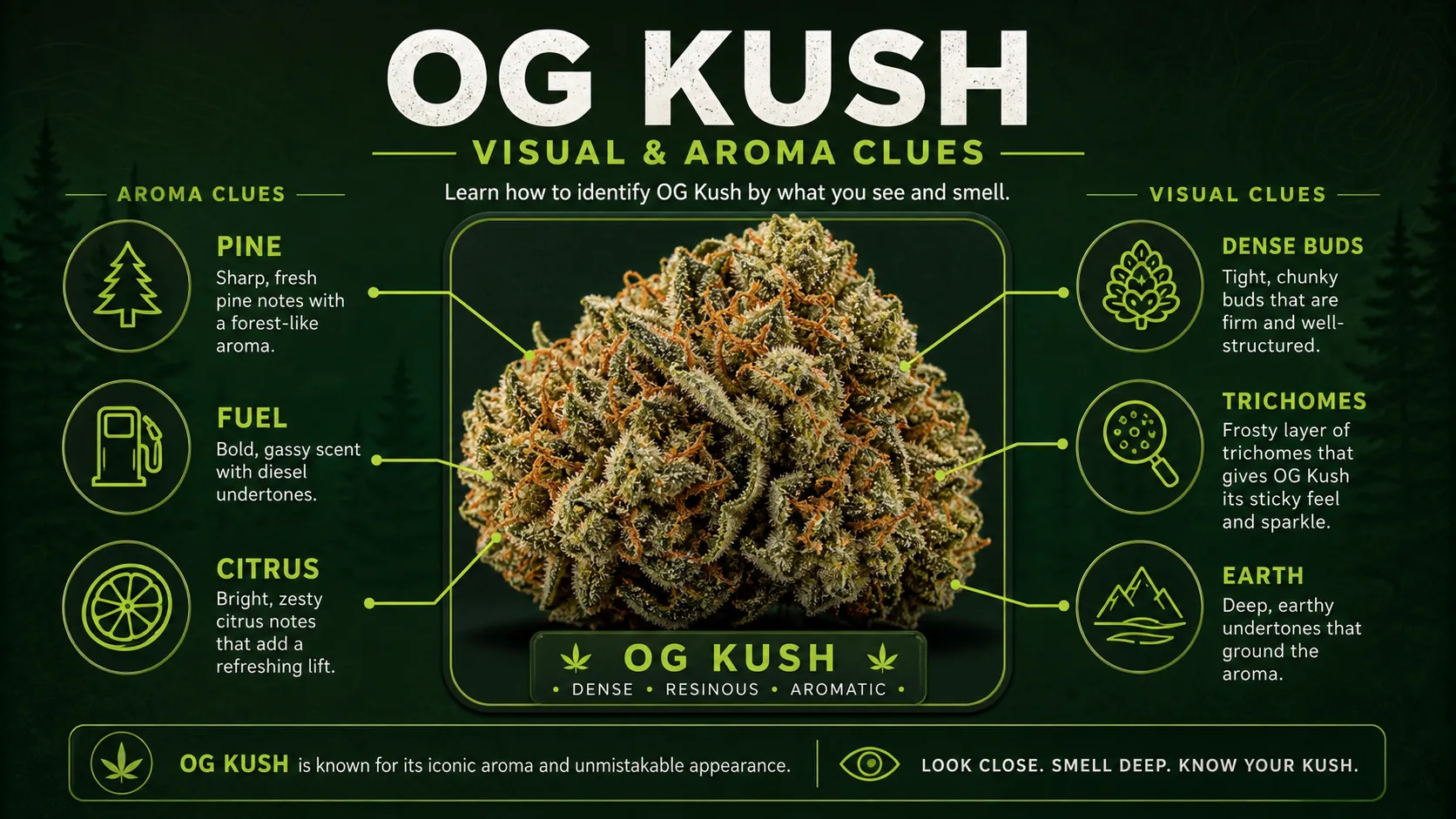
The classic OG Kush smell is usually described as a punchy mix of pine, lemon/citrus, pepper, earthy spice, and fuel. That “fuel” note is one reason OG-related strains often feel linked to Diesel and Chem-style cannabis in consumer language, even when the exact family tree is debated.
Terpenes help explain aroma, but they should not be turned into magic labels. Commonly discussed cannabis terpenes such as limonene, caryophyllene, myrcene, pinene, and others contribute to scent and flavor, while the full experience depends on many cannabinoids, terpenes, dose, product type, user tolerance, and context. A terpene label can be useful; it is not a promise of a specific effect.
What OG Kush flower can look like
Well-grown OG Kush-family flower often appears dense or chunky, with tight bracts, orange pistils, visible trichomes, and green tones that can range from lighter olive to deeper forest. Some batches lean more spear-shaped; others are rounder and more compact. Trim, cure, lighting, genetics, and handling all change the final look.
Visual clues can help you evaluate whether a sample looks fresh, mature, resinous, and well handled. They cannot prove exact strain identity. For that, it helps to compare the picture against known examples, then cross-check with label data, aroma, grower reputation, and lab results when available. Our guide to bud structure and cannabis quality explains where flower-shape clues are useful and where they stop.
Why OG Kush descendants are everywhere
Breeders use famous plants because famous plants give them a known vocabulary. OG Kush-style genetics can bring recognizable aroma, strong bag appeal, resin, and cultural credibility. That is why OG-related names appear across modern menus and why strains influenced by Kush, Chem, Diesel, Cookies, and Gelato families often overlap in consumer imagination.
This does not make OG Kush the parent of everything. Cannabis breeding is messy and often undocumented. But it did become a backbone strain — one of those names people use to explain other names. If a menu says a new hybrid has “OG funk,” most cannabis-literate shoppers understand the intended cue: pungent, piney, earthy, fuel-forward, and probably not subtle.
How to shop for OG Kush without getting fooled by the name
- Look beyond the label. Treat “OG Kush” as a starting clue, not proof.
- Check the batch date. Old flower can lose aroma and become dry even if the genetics are excellent.
- Smell for clarity. Pine, citrus, earth, pepper, and fuel can be expected; musty, grassy, ammonia-like, or chemical odors are warning signs.
- Inspect structure. Look for mature flower, visible resin, reasonable trim, and no fuzzy mold or suspicious residue.
- Read the COA if available. Cannabinoids, terpenes, contaminants, moisture, and batch testing matter more than folklore.
- Start low if you are inexperienced. Famous high-THC strains are not a competition. Dose and tolerance matter.
Where KushScan fits
KushScan can help you study OG Kush-style flower visually. A clear dry-bud photo can surface clues like bud density, pistil color, trichome coverage, trim pattern, and similarity to known strain examples. That is useful when you are comparing an unknown sample, learning cannabis families, or trying to understand why one “OG” looks different from another.
Use it honestly: a photo-based scan is an education and comparison tool, not a lab test or a genetic certificate. For more context, read our guide to how to identify a weed strain by picture and our beginner guide to cannabis genetics, phenotypes, and lineage.
Scan OG-style flower with KushScan
Take a sharp dry-flower photo and use KushScan to compare visible structure, color, trichome cues, and likely strain-style patterns — while keeping lab testing and source verification in the loop.
Download KushScanThe takeaway
OG Kush became an icon because it combined memorable aroma, cultural timing, breeder influence, and a name that kept traveling. But the smarter way to understand OG Kush is not blind label worship. Learn the history, notice the pine-fuel-citrus profile, respect the lineage uncertainty, and judge each batch by source, quality, freshness, and documentation.
Sources
- Leafly: OG Kush strain overview, used for mainstream strain-culture context and common consumer descriptions.
- DNA Genetics: OG Kush Cannabis Strain, used for cannabis-industry history, aroma, and disputed-origin context.
- Cannabis Chemovar Nomenclature Misrepresents Chemical and Genetic Diversity, peer-reviewed research on why strain names do not reliably capture chemical/genetic diversity.
- Genetic tools weed out misconceptions of strain reliability in Cannabis sativa, peer-reviewed research on genetic inconsistency and limits of consumer strain labels.
- NIH NCCIH: Cannabis, Marijuana, and Cannabinoids — What You Need To Know, federal health-information overview of cannabis, cannabinoids, THC, and CBD.