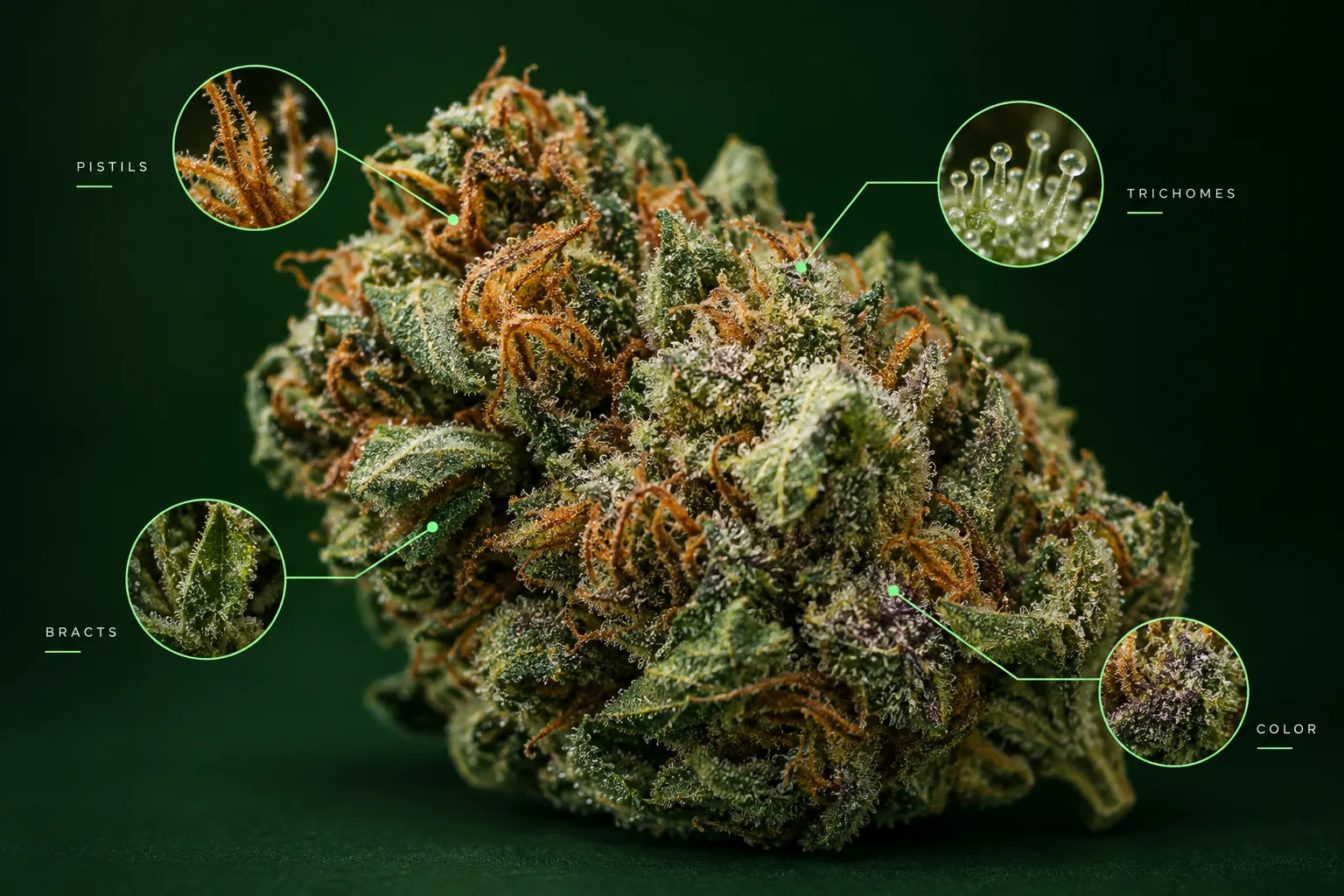
Few flower details stand out faster than bright orange hairs curling through a green or purple bud. They make cannabis look mature, textured, and photogenic. They also cause a lot of overconfident guessing: more orange must mean stronger weed, or red hairs must mean a certain strain, or white hairs must mean the flower was harvested too early.
The truth is more useful and less magical. Pistils are part of cannabis flower anatomy. Their color, curl, and distribution can add context to a photo, especially when you are comparing dry flower visually. But they are only one signal beside trichomes, bracts, bud structure, aroma, storage condition, package labels, and lab results.
Orange hairs on weed: the quick answer
Orange hairs on weed are usually pistils, sometimes called stigmas in plant-anatomy language. On a female cannabis flower, they help catch pollen while the plant is alive. In dry flower, they remain as visible thread-like hairs that often look orange, copper, amber, red, brown, or rust-colored.
- What they can suggest: flower maturity clues, visual texture, possible harvest-window context, and useful photo features for comparison.
- What they cannot prove: exact strain identity, THC percentage, terpene profile, indica/sativa effect, safety, or whether a batch is high quality.
- Best use: read pistils with trichome coverage, bud structure, color, aroma, batch labels, package date, and a Certificate of Analysis when available.
Think of pistils like a visual accent in the bigger cannabis profile. They help describe the flower. They do not certify what it is.
What cannabis pistils actually are
Cannabis is commonly grown for unfertilized female flowers. Botanical descriptions of cannabis note that female flowers are compact and include bracts that surround the ovary, with two slender stigmas projecting outward. Those projecting structures are the hairs most consumers notice on dry buds.
During flower development, cannabis inflorescences become dense clusters of small floral parts, bracts, pistils, and resin glands. Peer-reviewed research on female cannabis architecture describes glandular trichomes developing heavily on the bracts around the flower. That matters because the part people casually call a “bud” is not one simple object. It is a packed structure with reproductive parts, resin-rich surfaces, small leaves, and cured plant tissue all mixed together.
In other words, orange hairs are real anatomy, not decoration. But the resin-rich trichomes around them usually matter more for cannabinoids and aroma compounds than the hairs themselves.
Why pistils turn orange, red, or brown
Fresh pistils on a living cannabis plant often begin pale, white, cream, or yellowish. As the flower develops, many pistils darken, curl inward, and become more orange, amber, red, or brown. Drying and curing can deepen that color further, which is why finished flower often has rusty-looking hairs even when the living plant looked lighter.
That color shift can make pistils a rough maturity clue, especially for growers watching the same plant over time. For consumers looking at a finished nug in a jar, the clue is weaker. You usually do not know the cultivar, growth conditions, lighting, harvest date, drying process, trim style, or how the photo was edited.
Some cannabis naturally shows lots of orange pistils. Some looks more green and frosty. Some purple flower hides the hairs in darker contrast. None of those looks automatically means stronger, safer, fresher, or more effective cannabis.
Do orange hairs mean weed is strong?
No. Orange pistils do not measure potency. THC and other cannabinoids are associated mainly with glandular trichomes, the resin structures that appear as frost on cannabis flower. Reviews of cannabis trichomes describe them as specialized sites for cannabinoid and terpene production and storage.
That does not mean frosty flower always tests high, either. Visual inspection can suggest resin coverage, but lab testing is what measures cannabinoids. A bud with dramatic orange hairs may test modestly. A less colorful bud may test higher. Potency depends on genetics, chemistry, harvest timing, handling, storage, and the specific batch.
If a product claims a THC number, look for the batch-matched COA. Pistils can make a photo more readable, but they do not replace testing.
Can orange hairs identify a strain?
Orange hairs can help a flower photo feel familiar, but they cannot identify an exact strain. Many unrelated cultivars produce orange pistils. The same cultivar can show different pistil density and color across growers, phenotypes, harvest windows, lighting, curing, and storage.
This is where strain-name confusion gets real. If a bud has a green base, heavy frost, dense structure, and lots of orange hairs, it may resemble a familiar strain family. That resemblance is a comparison, not proof. Exact identity needs more context: packaging, source, batch history, genetics, and lab documentation. For the wider naming problem, read why cannabis strain names are so confusing.
KushScan can use pistils as one visual feature in a dry flower image, alongside color, bud shape, surface texture, trichome visibility, and other patterns. The app is most useful when you treat the result as a clue layer rather than a final certificate.
White hairs versus orange hairs
White or pale pistils are common on living, actively flowering cannabis plants. Growers may watch the percentage of pale versus darkened pistils as one harvest clue, though serious harvest decisions usually also consider trichome appearance, cultivar behavior, and the grower’s goals.
For store-bought dry flower, lots of bright white hairs are less common but not impossible. Photo lighting can make pale tan hairs look white. Heavy trichome frost can also be mistaken for hairs. If you are judging a dry bud from a picture, zoom out first: are you seeing long thread-like pistils, or tiny crystal-like resin heads?
For a deeper resin breakdown, see cannabis trichomes explained. For color context beyond pistils, use our weed color guide.
When pistils are a quality clue
Pistils are not a quality score, but they can support quality inspection when viewed with the rest of the flower.
- Intact, naturally colored pistils: can make a bud look well-handled and easy to inspect.
- Flattened or broken pistils: may suggest rough handling, tight packaging, or age, but are not a safety issue by themselves.
- Very dull brown flower with lifeless hairs: may point to old, dry, oxidized, or poorly stored cannabis when paired with weak aroma and brittle texture.
- Fuzzy white, gray, or web-like material: is not normal pistil color and should raise mold concerns, especially with musty smell.
Suspicious flower deserves caution. Do not use a pretty photo or an app result to override obvious mold, mildew, odd residue, or bad odor. Our moldy weed vs trichomes guide covers that visual distinction in more detail.
How to photograph pistils for better identification
If pistils are part of what you want to compare, make the photo honest:
- Use neutral light. Warm bulbs and phone flash can make hairs look more orange than they are.
- Keep the whole bud in frame. Extreme macro shots show pistils but hide structure.
- Use a plain background. A clean surface helps the camera expose the orange, green, purple, and white details accurately.
- Take one sharp photo from the side. Pistils, bracts, and trichomes are easiest to compare when the bud has depth.
- Avoid filters. Saturation and contrast edits can turn normal amber hairs into fake-looking neon orange.
That setup also helps with identifying a weed strain by picture, because a scanner or human reviewer gets real visual information instead of lighting artifacts.
Scan the whole flower, not just the hairs
KushScan can help compare dry cannabis flower photos using visible details like pistils, trichomes, color, bud structure, and surface texture. Use it with labels and COAs for a more grounded read.
Download KushScanThe takeaway
Orange hairs on weed are usually cannabis pistils, and they are useful visual clues for maturity, texture, and photo-based comparison. But they do not prove strain identity, potency, effects, freshness, or safety. Read pistils as one part of the flower’s visual story, then verify important claims with trusted sourcing, labels, batch records, and lab results.
Sources
- Plant Journal / PMC: Architecture and Florogenesis in Female Cannabis sativa Plants, peer-reviewed research on female cannabis flower development, bracts, stigmas, and trichome development.
- Canadian Food Inspection Agency: The Biology of Cannabis sativa L., botanical and reproductive background on cannabis, including female flowers and trichome types.
- Frontiers in Plant Science / PMC: Cannabis Glandular Trichomes: A Cellular Metabolite Factory, review of glandular trichomes as cannabinoid and terpene production/storage sites.
- PubMed: Cannabis glandular trichomes alter morphology and metabolite content during flower maturation, research on trichome maturation and metabolite variation in cannabis flowers.
- NIDA: Cannabis / Marijuana, public-health context on cannabis products, THC potency, and safety limits.