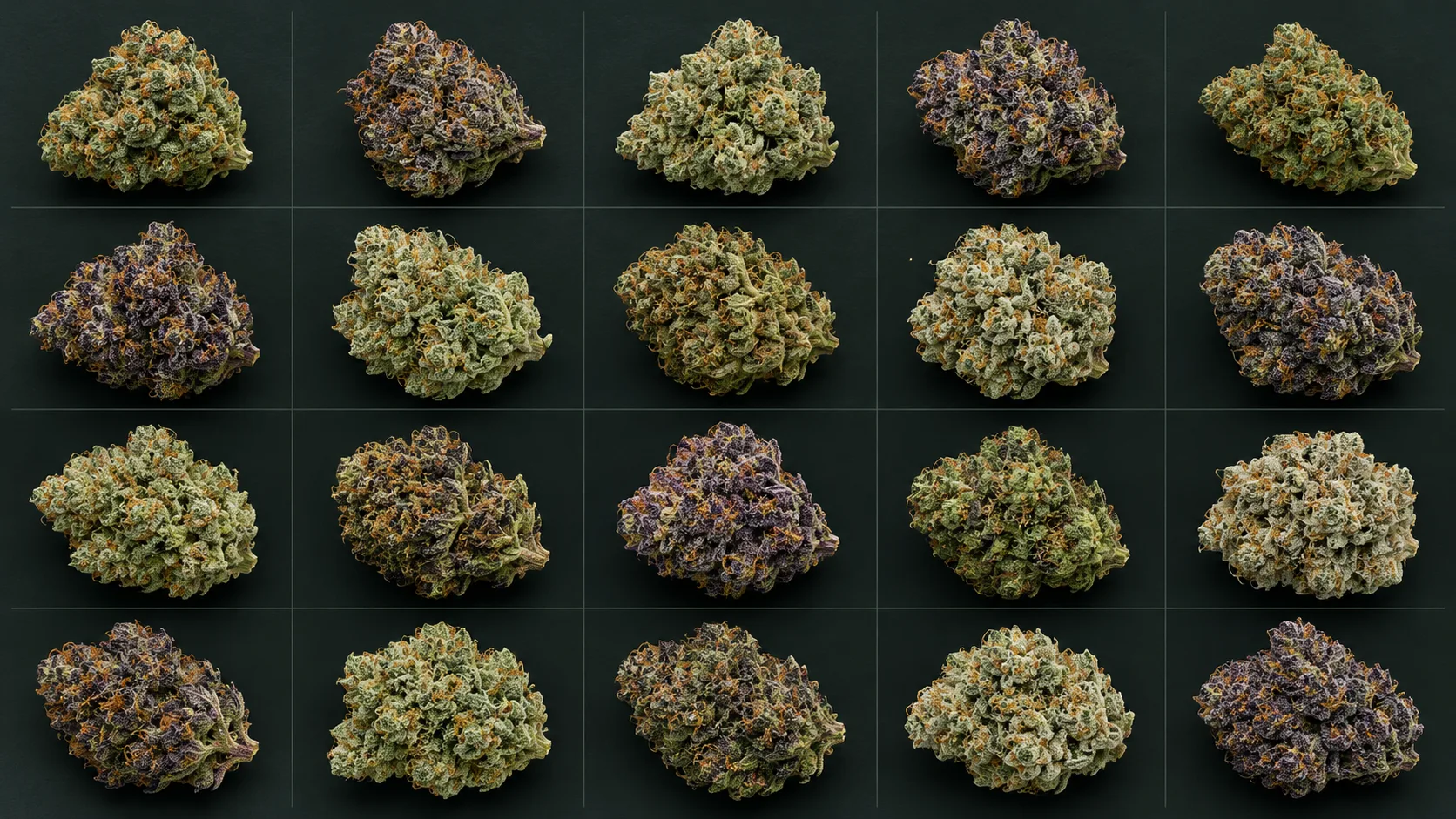
The current KushScan catalog: AK-47, Amnesia Haze, Blue Dream, Bubble Gum, Cheese, Chocolope, Durban Poison, G13, Girl Scout Cookies, Gorilla Glue, Green Crack, Hindu Kush, Jack Herer, Lemon Haze, Northern Lights, OG Kush, Pineapple Express, Pink Kush, Sour Diesel, and White Widow.
All 20 supported KushScan strains
| Strain | Useful identification context |
|---|---|
| AK-47 | A long-running hybrid name with different commercial expressions. |
| Amnesia Haze | A Haze-associated classic often discussed through elongated, lively flower structure. |
| Blue Dream | A widely recognized hybrid name with substantial producer and phenotype variation. |
| Bubble Gum | A classic sweet-associated strain name whose appearance still varies by source. |
| Cheese | A famous aroma-led family where smell context may be more distinctive than looks alone. |
| Chocolope | A sativa-associated classic often compared through looser flower structure. |
| Durban Poison | A historic South African-associated name with many modern market interpretations. |
| G13 | A legendary strain label surrounded by competing origin stories. |
| Girl Scout Cookies | A modern Cookies-family landmark commonly shortened to GSC. |
| Gorilla Glue | A resin-associated modern classic also encountered under names such as GG4. |
| Green Crack | A popular sativa-leaning commercial name with varied batches and cuts. |
| Hindu Kush | A classic Kush-associated name linked culturally with compact resinous flower. |
| Jack Herer | A long-running Haze-family hybrid with multiple phenotypic expressions. |
| Lemon Haze | A citrus-associated Haze label where aroma and source add important context. |
| Northern Lights | A foundational classic represented by different lines and retail expressions. |
| OG Kush | An influential family name with disputed history and broad modern variation. |
| Pineapple Express | A famous commercial hybrid label popularized through culture as well as cultivation. |
| Pink Kush | A Kush-associated market name often discussed through dense flower and color expression. |
| Sour Diesel | A classic fuel-associated name with a strong aroma reputation and variable appearance. |
| White Widow | A well-known 1990s hybrid associated culturally with pale visible resin coverage. |
How catalog-based strain matching works
When you submit one dry-flower photo, KushScan compares visible features with examples in its supported classes. Those features can include bud shape, density, texture, trichome appearance, color distribution, stems, pistils, and leaf balance. The output ranks visually plausible matches from the catalog.
This makes the result useful for comparison, but the catalog creates an important boundary. If the actual flower belongs to an unsupported strain, the closest result can still be one of the 20 known classes. Read our guide to weed strain identifier accuracy for more on closed catalogs and open-world identification.
What a supported-strain match means
- The photo shares visible patterns with labeled examples from that class.
- The match can help narrow possibilities and guide further research.
- The result should be read as probability or similarity, not genetic authentication.
- Packaging, producer details, batch records, aroma, and COAs can add context.
What it does not mean
- It does not prove the breeder, clone, phenotype, or exact lineage.
- It does not show that every product sold under that name will look alike.
- It does not measure THC, CBD, terpenes, pesticides, microbes, or heavy metals.
- It does not predict one person's effects or confirm medical suitability.
Why strain names still require context
Cannabis naming is historically useful but scientifically inconsistent. Research has found that products carrying the same commercial name can be genetically or chemically dissimilar, while differently named samples can share important similarities. Environment and post-harvest handling further change what the final flower looks like.
That does not make names useless. Names organize culture, lineage stories, shopping, and user expectations. They simply work better when combined with producer records, batch testing, aroma, and visible evidence. Explore the broader issue in why cannabis strain names are confusing.
How to get the best comparison
- Photograph one intact dry bud, not a live plant or processed product.
- Use bright indirect light and a neutral background.
- Keep the entire flower sharp while preserving visible surface texture.
- Avoid filters, colored LEDs, plastic bags, jars, hands, and multiple mixed buds.
- Take candidate photos if needed, then submit the single clearest frame.
- Compare the match with the label and COA instead of using the app as a replacement.
For strain history, start with our guides to OG Kush and Blue Dream, Sour Diesel, and GSC.
Compare your photo with the supported catalog
KushScan analyzes one clear dry-flower image and ranks likely visual matches from its current strain set. Keep the catalog boundary in mind and verify important claims separately.
Download KushScanThe takeaway
KushScan currently supports 20 recognizable strain names spanning classic Haze, Kush, Diesel, Cookies, and hybrid culture. That catalog makes the comparison understandable: a scan ranks resemblance within a known set. It does not search every cultivar or turn a photograph into proof of genetics or chemistry.
Sources
- Scientific Reports: Genetic tools weed out misconceptions of strain reliability in Cannabis sativa, research on commercial naming and genetic variation.
- Cannabis Chemovar Nomenclature Misrepresents Chemical and Genetic Diversity, research on strain-name and chemistry limitations.
- NCCIH: Cannabis, Marijuana, and Cannabinoids—What You Need To Know, NIH overview of cannabis compounds and complexity.