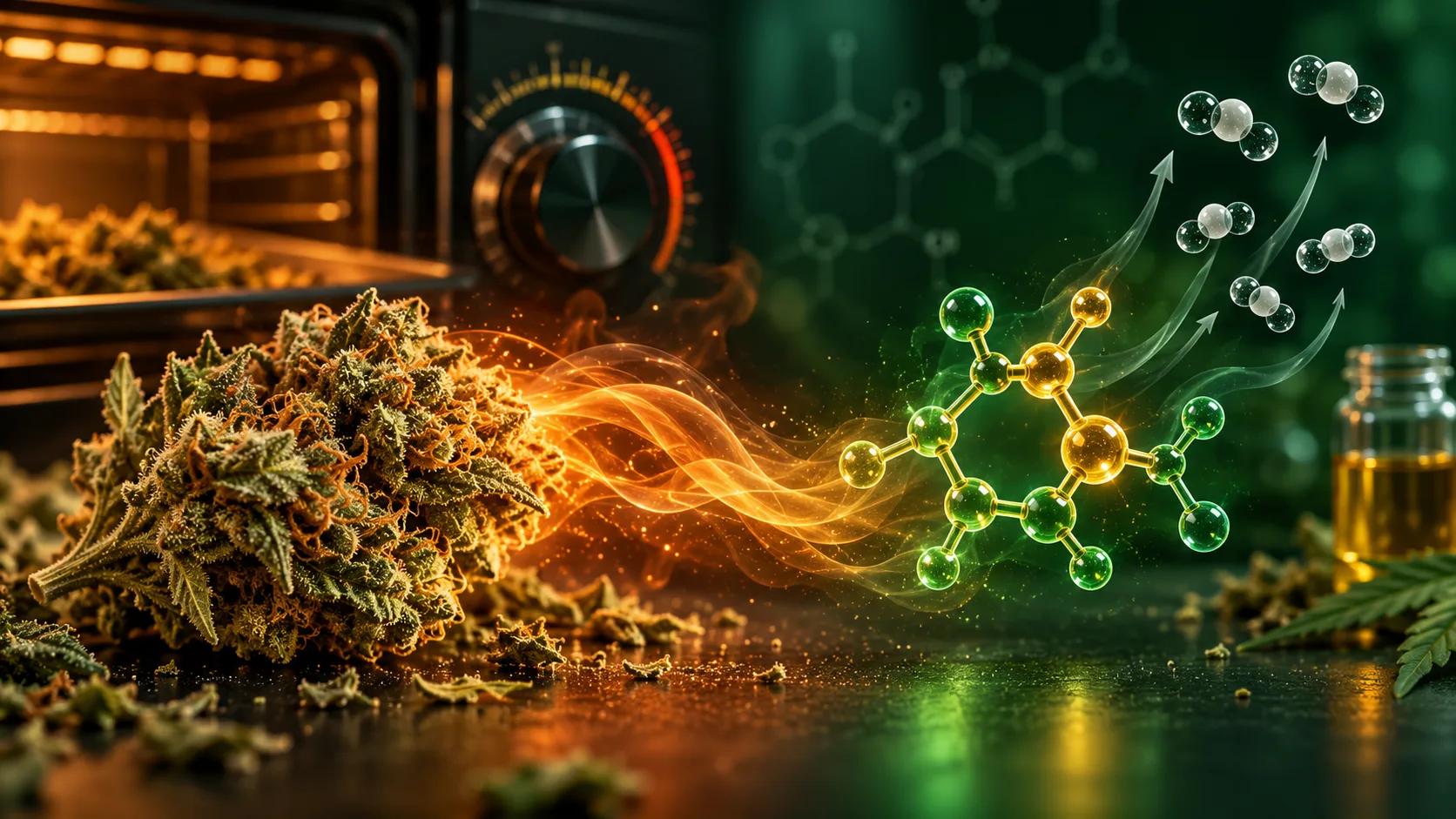
Short answer: decarboxylation removes a carboxyl group from a cannabinoid acid and releases carbon dioxide. Cannabis does some of this slowly through drying, storage, light, and time. Heating accelerates the reaction dramatically. The starting material, temperature, duration, airflow, moisture, and equipment all affect the result.
This is why raw flower chemistry can look very different from heated flower chemistry—and why an oven setting copied from the internet cannot guarantee a particular potency.
What is cannabis decarboxylation?
Fresh cannabis primarily produces many cannabinoids in their acidic forms. The “A” in THCA, CBDA, and CBGA indicates that extra carboxyl group. When heat or enough time supplies energy to the molecule, it can lose that group as carbon dioxide:
- THCA → THC + carbon dioxide
- CBDA → CBD + carbon dioxide
- CBGA → CBG + carbon dioxide
The reaction changes molecular mass and pharmacology. In particular, THCA and delta-9 THC are not interchangeable: THC is the main intoxicating cannabinoid, while THCA does not produce the same classic THC intoxication in its unheated form.
Why heat and time work together
Decarboxylation is a rate process. At a lower temperature, conversion generally takes longer. At a higher temperature, it happens faster—but extended or excessive heat can also reduce the amount of neutral cannabinoid recovered through degradation and other losses.
A controlled laboratory study of cannabis extracts illustrates the pattern. Below 100°C (212°F), THCA did not reach complete conversion within the study's 60-minute window. At 110°C (230°F), THCA approached zero in about 30 minutes; at 130°C (266°F), it did so in about 9 minutes. Those numbers describe specific extracts in a vacuum oven, not a universal kitchen schedule. Flower in a household appliance has different moisture, thickness, airflow, temperature swings, and oxygen exposure.
Different cannabinoid acids also move at different rates. In the same study, THCA decarboxylated faster than CBDA and CBGA. A single time-and-temperature claim therefore cannot be assumed to optimize every cannabinoid in every sample.
Why hotter is not automatically better
Fast conversion is only one goal. The neutral cannabinoids formed by heat can undergo further changes, and volatile aroma compounds can be lost. Research using other sample types and heating systems has found that neutral cannabinoid concentrations may begin to fall after longer exposure at high temperatures.
The important trade-off is:
- Too little heat or time: more acidic cannabinoid may remain.
- More controlled heat: conversion proceeds more quickly.
- Too much heat or time: additional losses and degradation become more likely.
This is also why decarboxylation experiments that use extracts, pressure, vacuum, sealed vessels, or analytical instruments should not be treated as direct instructions for dry flower at home.
Does smoking or vaping decarboxylate cannabis?
Yes. Smoking and vaporization expose cannabis to enough heat for rapid decarboxylation, although combustion and high temperatures also create degradation products and losses. Health Canada notes that THCA can change into THC during vaporization, cooking, smoking, and even the heated inlet of a gas chromatograph.
That does not mean every molecule converts or that the delivered dose equals the starting label. Device temperature, combustion, puff pattern, material condition, and losses between the product and the user all matter. A laboratory's “total THC” value is a chemistry calculation, not a promise of how much THC a person will absorb.
Decarboxylation and edibles
Decarboxylation is relevant to infused foods because simply mixing raw flower into food does not create the same cannabinoid profile as heating it. But home preparation is especially difficult to dose reliably: flower may not be uniform, appliances cycle around their set temperature, extraction can be incomplete, and portions may not contain equal amounts.
Edibles also have a different risk profile from inhaled cannabis. The CDC says intoxicating effects may take 30 minutes to 2 hours to appear and can last longer than expected, increasing the risk of taking too much. Keep any cannabis-containing food in a locked, child-resistant container, clearly separated from ordinary food and away from children and pets. Follow local laws, and never drive while impaired.
Why “total THC” uses 0.877
When THCA loses carbon dioxide, the resulting THC molecule weighs less. Laboratories and regulators commonly account for that mass difference with this theoretical calculation:
Total THC = delta-9 THC + (THCA × 0.877)
For example, a lab result with 20% THCA and 1% delta-9 THC has a theoretical total THC of about 18.54%: 1 + (20 × 0.877). This is not evidence that heating at home will recover every bit of that amount. It is a standardized way to express potential THC after adjusting for the carbon dioxide mass that is lost.
Our cannabis COA guide explains how to match a report to a batch and interpret cannabinoid results without confusing theoretical totals with an exact consumed dose.
Can a photo show whether cannabis is decarboxylated?
No. A photo may show browning, dryness, or changes in texture, but those clues cannot quantify THCA-to-THC conversion. Similar-looking flower can have very different chemistry, and visual changes may also come from age, oxidation, poor storage, or overheating.
A strain name cannot answer the question either. Genetics influence the cannabinoids a plant can produce, but processing determines how much remains in acidic or neutral form. Measuring that balance requires a properly sampled laboratory method capable of separating THCA from THC and the other cannabinoids.
Common decarboxylation myths
- “Raw flower contains no THC.” Many samples contain some delta-9 THC alongside much more THCA; the exact amounts require testing.
- “Brown means fully decarboxylated.” Color is not a cannabinoid assay. Browning can reflect several unrelated chemical changes.
- “There is one perfect temperature.” The best conditions depend on the cannabinoid, material, equipment, environment, and intended analytical or manufacturing goal.
- “Total THC is the amount your body receives.” It is a theoretical mass calculation. Processing losses and human absorption make actual exposure different.
- “More heat creates more THC indefinitely.” Once THCA has converted, continued heating can produce losses rather than extra THC.
Use the right tool for the question
KushScan can compare a clear dry-flower photo with examples in its supported strain catalog. It cannot see decarboxylation, measure cannabinoids, or replace batch-specific laboratory testing.
Download KushScanThe takeaway
Cannabis decarboxylation removes carbon dioxide from acidic cannabinoids, changing THCA into THC, CBDA into CBD, and CBGA into CBG. Heat accelerates the reaction, but temperature, time, material, moisture, oxygen, and equipment all shape the outcome. Read “total THC” as a theoretical laboratory calculation, not an exact dose, and rely on a batch-matched COA—not appearance—for cannabinoid measurements.
Sources
- Journal of Chromatography A / PMC: Decarboxylation Study of Acidic Cannabinoids, controlled time-and-temperature study of THCA, CBDA, and CBGA in cannabis extracts.
- Health Canada: Information for health care professionals—cannabis and cannabinoids, overview of cannabinoid chemistry, heating, stability, and routes of use.
- NIST: Cannabis Quality Assurance Program, Exercise 1 Final Report, laboratory guidance and the 0.877 total-THC calculation.
- CDC: Cannabis and Poisoning, edible onset, unpredictability, poisoning risk, and safe-storage guidance.