This is educational context, not legal advice. Cannabis rules change often, and the details depend on where you are, what product you have, your age, whether you are a patient, where you use it, and whether you cross state or national borders.
The easiest way to understand the US cannabis market is to separate three layers: federal law, state law, and product regulation. Most confusion comes from mixing those layers together.
US cannabis legalization overview: why the map is so confusing
At the federal level, cannabis has historically been regulated under the Controlled Substances Act. The DEA explains that the CSA places controlled substances into schedules and includes a formal process for adding, removing, or moving substances between schedules based on factors such as medical use, potential for abuse, scientific knowledge, and safety or dependence risk.
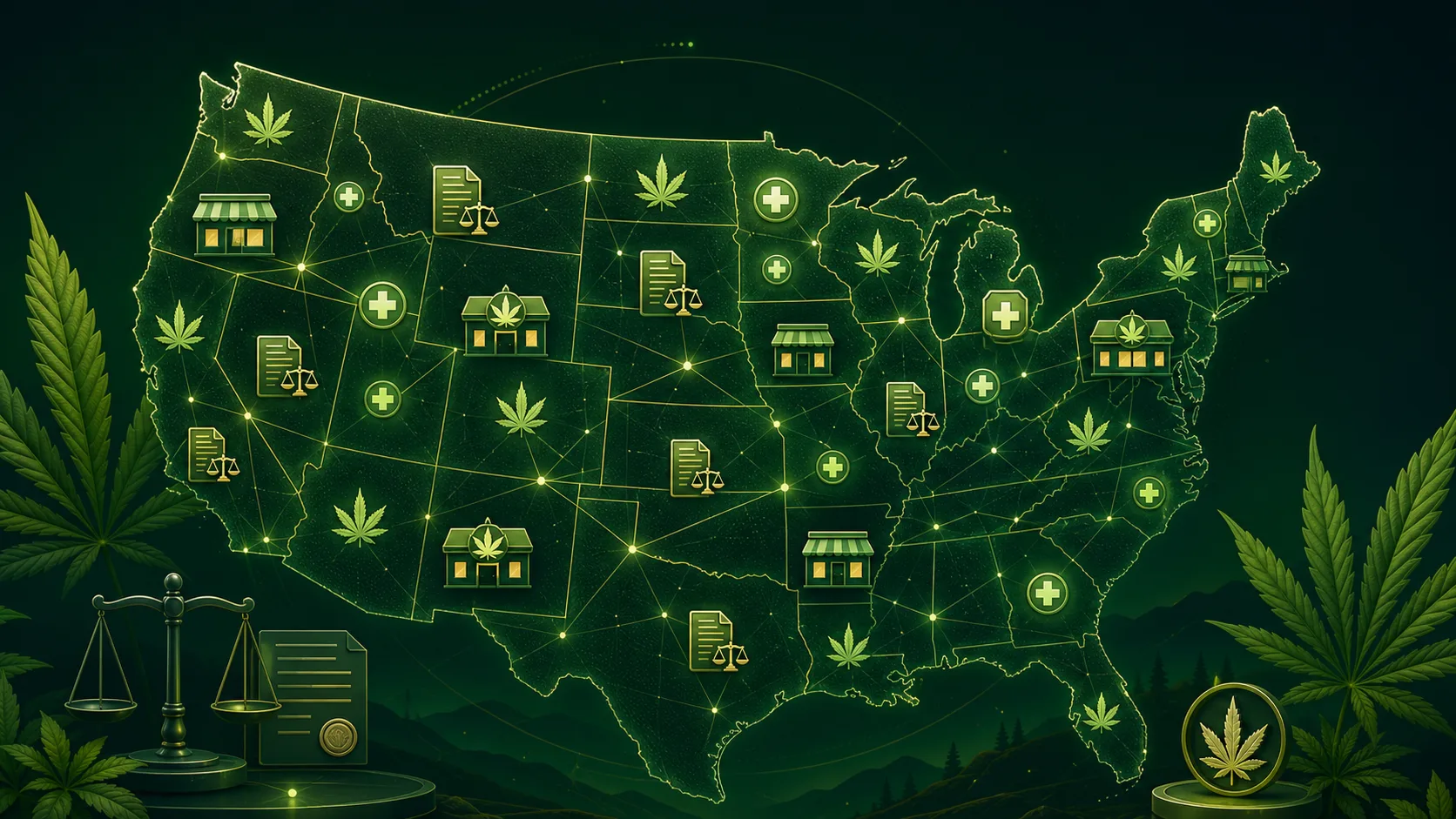
At the state level, the picture is very different. Many states have chosen to allow medical cannabis, adult-use cannabis, decriminalization, or some combination of those policies. That means “legal weed” in everyday conversation usually means “legal under this state’s rules,” not “fully legal everywhere in the United States.”
That federal-state gap is the core tension. The Congressional Research Service has described a significant divergence between federal and state marijuana law: state programs can authorize cannabis activity locally while many cannabis-related activities may still raise federal-law issues.
Medical cannabis vs adult-use cannabis
State cannabis programs usually fall into two broad categories:
- Medical cannabis: access is limited to qualifying patients, often with registration, physician certification, purchase limits, approved conditions, and patient-specific protections.
- Adult-use cannabis: adults over a state-defined age, commonly 21+, may buy or possess limited amounts under that state’s rules without needing a medical card.
Medical programs came first in many places, so an adult-use state often still has a separate medical system. The products may overlap, but the rules can differ for purchase limits, taxes, potency caps, home cultivation, caregiver access, reciprocity for out-of-state patients, and where products can be bought.
For consumers, the practical point is simple: a label that is legal in one state does not automatically travel with you. Possession limits, home-grow rules, public-use restrictions, impaired-driving laws, workplace policies, landlord rules, and airport rules may all be separate questions.
Legalization, decriminalization, and regulated sales are not the same thing
People often use legalization as a catch-all word, but policy can mean several different things:
- Decriminalization: possession of small amounts may be treated less like a criminal offense, but legal commercial sales may not exist.
- Medical legalization: qualifying patients can access cannabis through a regulated medical program.
- Adult-use legalization: adults can possess or buy cannabis under state rules.
- Regulated commercial sales: licensed dispensaries, testing rules, packaging standards, taxes, tracking systems, and enforcement agencies exist.
- Home cultivation: some states allow limited home growing; others do not, or allow it only for patients.
That is why a headline saying a state “legalized cannabis” does not tell the whole story. You still need to know what changed: possession, purchasing, cultivation, licensing, social consumption, expungement, taxation, or enforcement priorities.
Where hemp fits into the cannabis legalization debate
Hemp is cannabis too, but federal law treats it differently when it meets the legal THC threshold. The 2018 Farm Bill removed hemp — generally cannabis with no more than 0.3% delta-9 THC by dry weight — from the federal definition of marijuana. That opened the door for hemp-derived products, including CBD and many intoxicating hemp products sold outside traditional dispensary systems.
This created a new source of confusion. A product may be marketed as hemp-derived while still containing cannabinoids that feel intoxicating, such as delta-8 THC or converted THC variants. FDA materials warn that cannabis-derived products are regulated across a complicated framework and that some products, especially those sold as foods, supplements, or copycat snacks, can raise consumer-safety concerns.
For everyday buyers, the hemp label is not a quality guarantee. Check the certificate of analysis when available, understand the cannabinoid profile, avoid products designed to look like ordinary candy or snacks, and be extra cautious with edibles because effects can be delayed and stronger than expected.
What rescheduling would change — and what it would not
Federal cannabis rescheduling is often discussed as if it would instantly legalize dispensaries nationwide. That is not accurate. Moving cannabis to a less restrictive federal schedule could affect research, prescribing rules, tax treatment, enforcement priorities, and regulated medical pathways, depending on the exact rule. But it would not automatically make every state-licensed adult-use market fully federally legal, and it would not erase state-by-state differences.
The better way to think about rescheduling is “federal classification reform,” not total legalization. Descheduling, federal legalization, banking reform, tax reform, research expansion, and interstate commerce are related but separate policy questions.
What consumers should actually look for
If you live in or visit a legal-market state, the safest shopping mindset is not just “is cannabis legal here?” It is:
- Buy from licensed sources: licensed dispensaries are more likely to follow state testing, labeling, packaging, and track-and-trace rules.
- Read the label: look for THC, THCA, CBD, serving size, batch number, package date, warnings, and producer information.
- Ask for the COA: a certificate of analysis can show cannabinoids, terpenes, and screening for contaminants where testing is required.
- Know the local rules: possession limits, public use, driving, home grow, and travel restrictions matter.
- Be careful with edibles: start low, wait long enough, and do not mix with alcohol or driving.
- Respect age and workplace rules: state legality does not necessarily protect every job, lease, school, or federal setting.
CDC and NIDA materials both emphasize that cannabis effects depend on factors such as THC concentration, product type, frequency of use, prior experience, biology, and use with alcohol or other drugs. Legal status does not remove impairment risk.
How legalization affects strain names and product trust
Legal markets can improve transparency because licensed products may include testing, batch labels, package dates, and scannable compliance information. That helps consumers compare flower beyond the strain name.
But legalization does not make strain names perfectly reliable. “Blue Dream,” “OG Kush,” or “Gelato” can still vary by grower, phenotype, batch, harvest timing, storage, and local naming habits. If you want to understand what is actually in the jar, combine the name with the producer, COA, terpene profile, freshness, and visual quality.
For more on that, read our guide to cannabis genetics, our explanation of terpenes in weed, and our practical guide to identifying a weed strain by picture.
Use KushScan as one clue, not a legal shortcut
KushScan can help you compare dry cannabis flower photos for structure, color, trichome cues, and possible strain-pattern similarity. It cannot tell you whether a product is legal where you are, prove lab potency, or replace a licensed COA. Use it alongside labels, testing, local rules, and responsible choices.
Download KushScanThe takeaway
The United States does not have one simple cannabis rulebook. Federal law, state medical systems, adult-use markets, hemp rules, product testing, workplace policies, and travel restrictions all overlap. The smart consumer move is to avoid slogans and read the actual context: where you are, what product you have, who made it, how it was tested, and what the local rules allow.
Sources
- National Conference of State Legislatures: Cannabis Overview, current state policy tracker and high-level explanation of medical and adult-use cannabis laws.
- Congressional Research Service: State Marijuana “Legalization” and Federal Drug Law, overview of the federal-state law split, hemp definition, and rescheduling context.
- Drug Enforcement Administration: The Controlled Substances Act, federal explanation of scheduling and how substances can be controlled, transferred, or decontrolled.
- NIDA: Cannabis (Marijuana), NIH overview of cannabis, THC, public-health research, potency, and policy context.
- CDC: About Cannabis, public-health overview of cannabinoids, product types, THC concentration, and risk factors.
- FDA: Regulation of Cannabis and Cannabis-Derived Products, federal consumer and regulatory resource for cannabis-derived products including CBD and delta-8 THC.