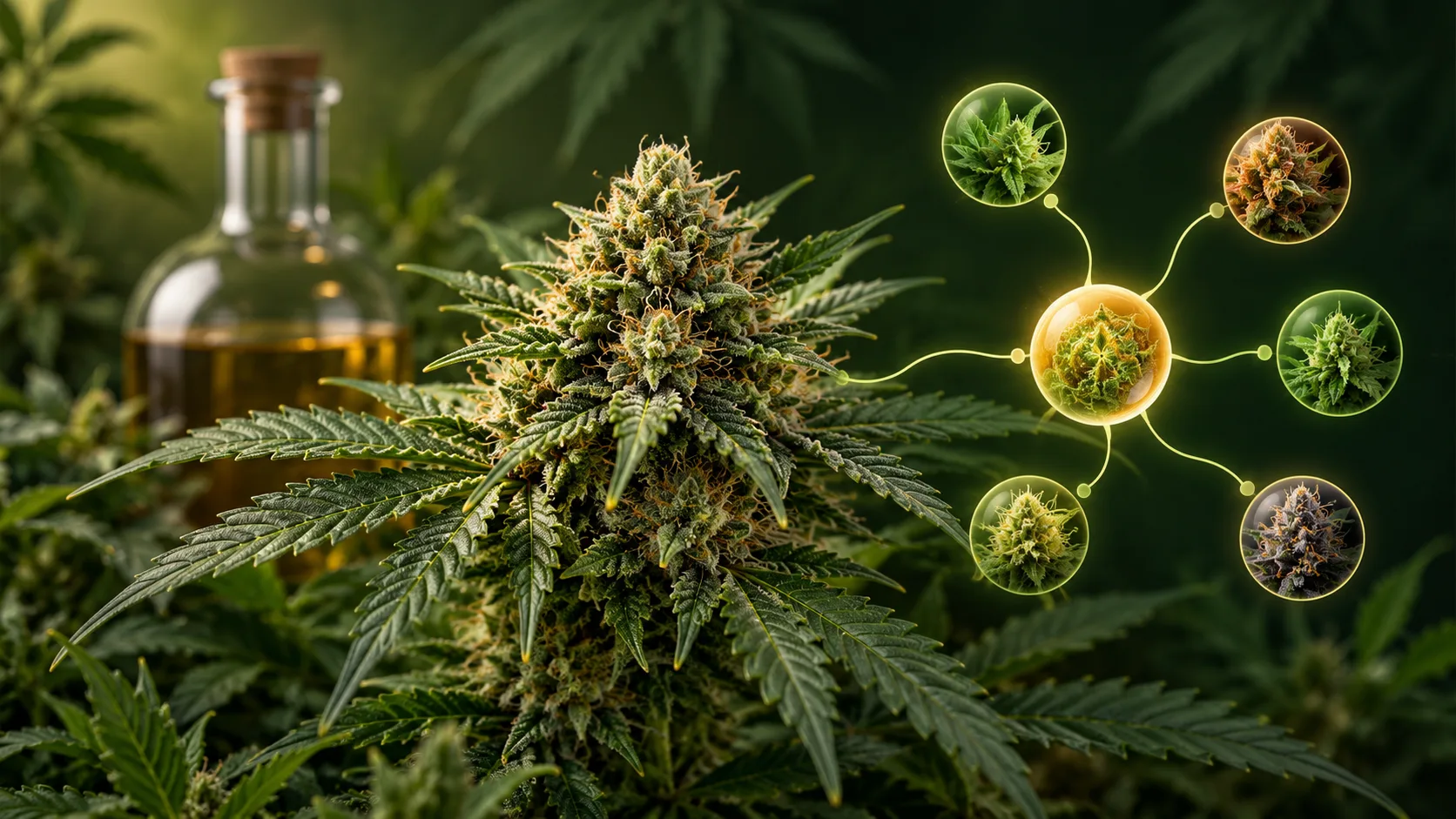
Short answer: CBG is a minor phytocannabinoid made when its acidic form, CBGA, loses carbon dioxide through heat or time. In the living plant, CBGA—not neutral CBG—is the important starting material used to form acidic cannabinoids including THCA, CBDA, and CBCA. Those acids can later become THC, CBD, and CBC.
Interest in CBG products has grown faster than the clinical evidence. Laboratory and animal research has produced many hypotheses, but only a small number of controlled human studies have been published. That makes CBG scientifically interesting, not a proven cure-all.
What is CBG in cannabis?
Cannabigerol belongs to the large family of chemical compounds called cannabinoids. Cannabis makes these compounds mainly in acidic forms. As the plant develops, enzymes direct CBGA into different branches of its biosynthetic pathway:
- CBGA → THCA → THC after decarboxylation
- CBGA → CBDA → CBD after decarboxylation
- CBGA → CBCA → CBC after decarboxylation
- CBGA → CBG when CBGA itself decarboxylates
Decarboxylation is the removal of a carbon dioxide group, commonly accelerated by heat. This is the same basic idea behind the conversion of THCA into THC.
Because much of a plant's CBGA may be routed into other cannabinoid acids, mature flower commonly contains less CBG than its headline cannabinoids. Breeding, harvest timing, plant genetics, environment, processing, and testing method can all affect the measured amount.
Why “the mother cannabinoid” is an imperfect nickname
Calling CBG the mother of all cannabinoids makes a catchy label, but it collapses two different molecules into one. CBGA is the central biosynthetic precursor; CBG is the neutral compound formed from CBGA. And the pathway is a network, not a family tree in which bottled CBG turns into THC or CBD inside your body.
A more accurate summary is: CBGA provides starting material for several major cannabinoid-acid pathways inside the cannabis plant. Neutral CBG is one resulting cannabinoid with its own pharmacology.
CBG vs CBD vs THC
- THC: the main intoxicating cannabinoid in cannabis. It strongly engages CB1 receptors and can impair attention, memory, coordination, and reaction time.
- CBD: generally does not produce a THC-like high. It has a different, complex target profile and substantially more human research than CBG. One purified CBD medicine has FDA approval for specific seizure disorders.
- CBG: has not produced classic THC-like intoxication in limited research, but its mechanisms and real-world effects are less thoroughly characterized. “Non-intoxicating” should not be confused with “proven safe for everyone.”
Products complicate the comparison. A bottle labeled “CBG” may contain CBD, THC, other cannabinoids, terpenes, carrier oils, or contaminants. Effects depend on the actual formulation and dose—not just the largest letters on the package.
What does human research on CBG show?
Most proposed CBG benefits still come from cell studies, animal models, or reviews of preclinical work. These can identify biological targets and justify better trials, but they cannot show that a retail product treats a condition in people.
A small 2024 double-blind, placebo-controlled crossover study gave 34 healthy adults 20 mg of hemp-derived CBG or placebo in remote sessions. Researchers reported lower self-rated anxiety and stress with CBG and no evidence of subjective intoxication or impairment in their measures. The study was valuable as an early experiment, but its small sample, acute single-dose design, remote setting, and healthy participants limit how widely its findings can be applied.
A later randomized placebo-controlled trial studied daily oral CBG in 63 veterans with sleep concerns; 35 completed without major protocol deviations. Sleep scores improved in both groups, with no statistically significant difference between CBG and placebo. Mild possibly related events included headache, lethargy, stomach upset, nausea, and excessive sleepiness. The authors concluded that efficacy could not be established and further study was warranted.
Together, these studies do not support either extreme: it is premature to dismiss CBG as inactive, and equally premature to advertise it as an established treatment for anxiety, sleep, pain, inflammation, cancer, glaucoma, or other conditions.
Is CBG FDA-approved?
No CBG product has FDA approval to diagnose, cure, mitigate, treat, or prevent a disease. FDA's cannabis research page says the agency has approved one cannabis-derived medicine—purified CBD—and three synthetic cannabis-related medicines for specific uses. That does not validate over-the-counter CBG oils, gummies, capsules, flower, or cosmetics.
Approval matters because it requires evidence for a defined product, dose, use, quality standard, and risk profile. A promising molecule and a clinically proven medicine are not the same thing.
CBG safety and drug-interaction questions
Human safety data remain limited, especially for repeated use, high doses, pregnancy or breastfeeding, liver or kidney disease, and combinations with prescription medicines. Different routes—swallowed oil, inhaled flower, or topical products—also create different exposure.
Use extra caution if a product contains THC or if you take medicines that cause drowsiness or have a narrow therapeutic window. Because comprehensive interaction data for CBG are not available, a pharmacist or clinician is the right person to assess a specific medicine combination. Avoid driving or other safety-sensitive tasks until you know how the complete product affects you.
How to read a CBG product label
- Find CBG per serving, not just per package. A large front-label number may describe the entire bottle.
- Check the full cannabinoid panel. Look for CBG, CBGA, CBD, THC, THCA, and other detected cannabinoids.
- Match the batch. The lot number on the product should match the certificate of analysis (COA).
- Read the test date and laboratory name. Recent, batch-specific documentation is more useful than a generic sample report.
- Review contaminant testing. Depending on the product and local rules, that may include pesticides, heavy metals, microbes, mycotoxins, and residual solvents.
- Ignore disease-treatment promises. Marketing language is not clinical evidence or FDA approval.
Our guide to reading a cannabis COA explains how to verify the batch and interpret potency and safety sections without treating one report as a universal guarantee.
Can you see CBG in a cannabis photo?
No. A photo can show flower structure, trichome coverage, color, trim, and condition, but cannabinoids are molecules, not visible labels. Frosty flower is not proof of high CBG, high THC, or any exact potency. Those questions require properly sampled laboratory analysis.
Even a strain name associated with CBG-rich breeding cannot authenticate the chemistry of a specific batch. Genetics influence what a plant can produce, while cultivation, harvest, storage, processing, sampling, and test methods all shape the final result. Use visual identification as a comparison tool and the batch-matched COA for measured chemistry.
Use photos for visual clues—not chemistry claims
KushScan compares a clear dry-flower photo with examples in its supported strain catalog. It can help you explore visible similarities, but it cannot measure CBG, THC, CBD, contaminants, or medical effects from an image.
Download KushScanThe takeaway
CBG is a minor cannabis cannabinoid formed from CBGA. The better-known “mother cannabinoid” story really belongs to CBGA's role as a shared precursor inside the plant. Early human research on CBG is beginning to appear, but it is small and mixed, and no CBG product is FDA-approved as a medicine. Treat benefits as research questions, check a batch-specific COA, and bring health or drug-interaction questions to a qualified professional.
Sources
- Pharmacological Reviews: Minor Cannabinoids—Biosynthesis, Molecular Pharmacology and Potential Therapeutic Uses, peer-reviewed review of CBGA biosynthesis and CBG pharmacology.
- Scientific Reports / PubMed: Acute effects of cannabigerol on anxiety, stress, and mood, 2024 double-blind, placebo-controlled crossover study in 34 healthy adults.
- Medical Cannabis and Cannabinoids / PMC: Effect of Cannabigerol on Sleep and Quality of Life in Veterans, randomized placebo-controlled trial reporting no significant between-group improvement in its primary sleep outcome.
- FDA: Cannabis Research and Drug Approval Process, current federal drug-approval context for cannabis-derived and cannabis-related products.