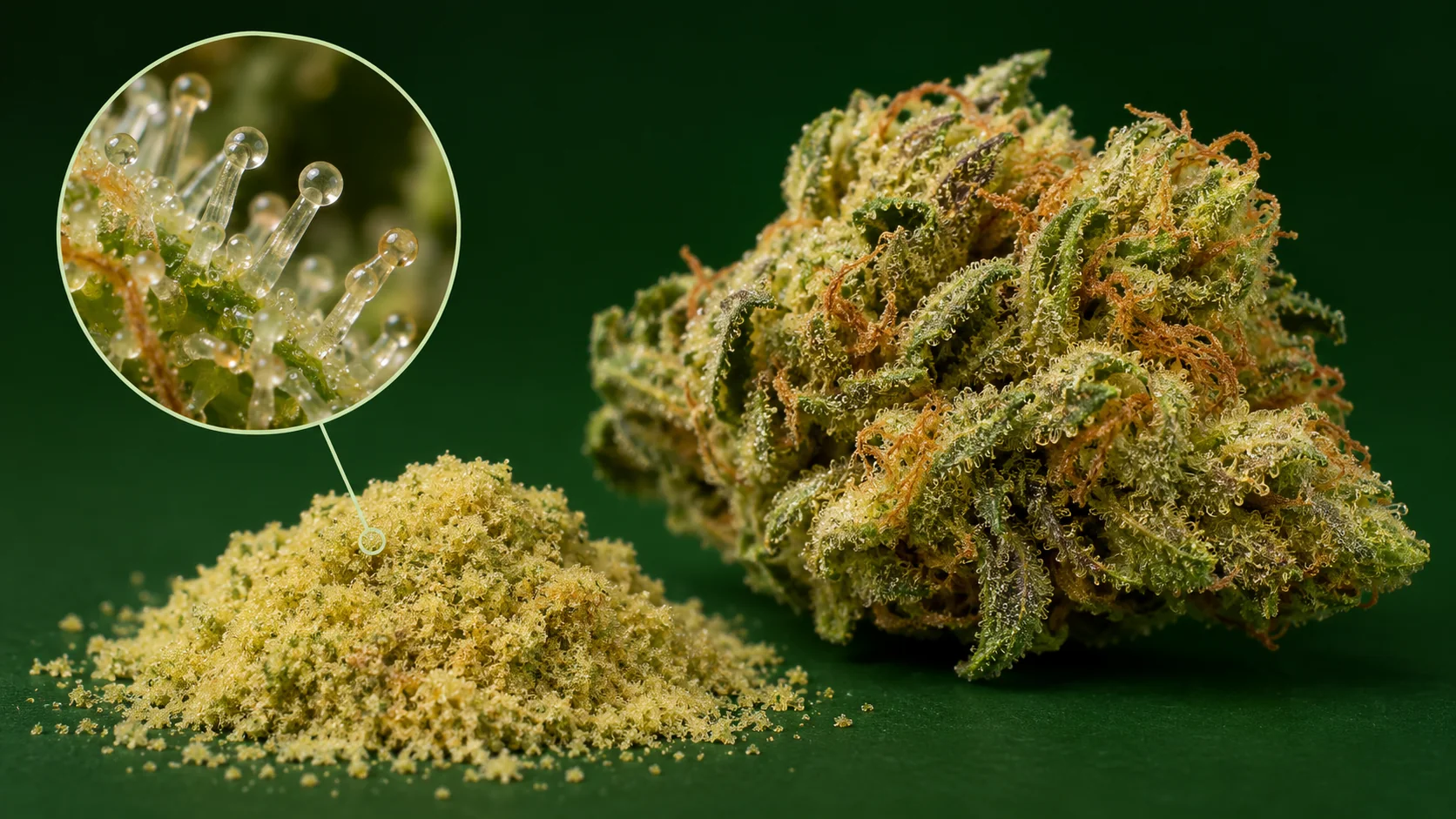
Open the bottom chamber of a multi-part grinder and you may find a fine layer of pale green or sandy material. That is commonly called kief. It comes from the same structures that give cannabis flower its frosty surface, sticky feel, and much of its cannabinoid and aroma chemistry.
The simple definition hides useful details. Kief can vary in plant-particle content, cannabinoid profile, freshness, aroma, color, and cleanliness. It is usually more concentrated than the flower it came from, but a photograph cannot tell you its exact strength or whether it is free from contaminants.
What is kief in 60 seconds?
- What it is: loose cannabis trichomes and trichome fragments, usually mixed with some fine plant material.
- Where it comes from: the resin glands concentrated on female cannabis flowers and nearby sugar leaves.
- How it separates: dry flower handling, grinding, or mechanical sifting can detach the brittle glands.
- Why it can be stronger: glandular trichomes produce and store cannabinoids and terpenes, so collecting them concentrates resin-rich material relative to whole flower.
- Kief vs hash: kief is generally loose and unpressed; hash is made by collecting and further processing or pressing separated trichomes.
- What appearance cannot prove: exact THC, strain identity, purity, freshness, safety, or absence of adulterants.
Where kief comes from: glandular trichomes
Cannabis flowers carry several kinds of surface hairs. The ones most relevant to kief are glandular trichomes: microscopic secretory structures that produce and accumulate cannabinoids and terpenes. On mature flowers, capitate-stalked trichomes resemble tiny mushrooms, with a rounded gland head supported by a stalk.
Peer-reviewed microscopy research shows that cannabis trichomes differ in size, structure, chemistry, and stage of development. The abundant stalked glands on flower bracts are especially important to the plant’s resin chemistry. Drying and post-harvest handling can bend, collapse, rupture, or detach them. Once enough detached heads and fragments collect together, the material becomes recognizable as kief.
This is why “crystals” is an imperfect nickname. Trichome glands can sparkle under light, but they are biological plant structures containing resin, not mineral crystals or added sugar.
How kief is collected
Some kief appears incidentally as dry flower moves through a container or grinder. Purpose-made dry-sifting methods use screens to separate small trichome particles from larger pieces of leaf and flower. Health Canada classifies kief produced through mechanical actions such as sifting, beating, or rubbing as a cannabis extract under its regulations, illustrating an important point: separating resin-rich structures changes the product category even without a solvent.
Screen size, number of passes, flower condition, temperature, handling, and operator technique all influence the result. A very fine-looking pile is not automatically purer. Small plant fragments can pass through a screen too, while rough handling can break more leaf material into the collection.
Kief vs hash vs grinder dust
| Material | Typical form | Practical distinction |
|---|---|---|
| Kief | Loose, sandy or powdery | Separated trichomes and fragments with varying amounts of plant material |
| Dry-sift hash | Pressed, shaped, or cohesive | Kief-like material that has been further collected, refined, and often pressed |
| Grinder dust | Fine mixed debris | May contain useful trichomes, but often includes more pulverized leaf and flower |
| Flower | Whole or broken buds | Trichomes remain attached to bracts and sugar leaves rather than separated |
These categories overlap in everyday language. “Pollen” is another slang term for kief, although cannabis kief is not the same thing as botanical pollen from male flowers. The most useful questions are how the material was separated, how much non-gland plant matter remains, and whether batch-level testing is available.
Is kief stronger than flower?
Kief is commonly more cannabinoid-dense than the flower it came from because it enriches the structures where cannabinoid acids such as THCA, CBDA, and CBGA are produced and stored. That does not create one standard potency. The starting flower’s chemistry, trichome recovery, plant contamination, age, and processing all matter.
Color, sparkle, clumping, and aroma cannot provide an exact THC percentage. Pale material may contain a high proportion of gland heads, but lighting and cultivar color can mislead. Greener material may contain more leaf fragments, yet a photo cannot quantify the difference. Only representative laboratory analysis can report batch-specific cannabinoid values.
Concentration also changes the caution needed around a product. Higher-THC cannabis can produce stronger impairment and unwanted effects. Labels and local regulations should guide consumers where legal products are available; visual inspection should not substitute for that information.
What kief color and texture can tell you
- Light gold, tan, or olive: common colors for dry-sifted material, influenced by the starting plant and amount of fine plant matter.
- Bright green: can suggest more leaf or flower fragments, but it is not a laboratory purity measurement.
- Loose and sandy: common when dry and recently separated.
- Clumped or oily: may reflect resin, warmth, pressure, or moisture. Clumping alone does not prove freshness or potency.
- Darkening over time: can occur with age, oxidation, heat, and handling; the degree cannot be dated reliably from a picture.
Look for condition clues rather than attempting a definitive grade. Unexpected fibers, fuzzy growth, musty odor, wetness, insect debris, or foreign particles deserve caution. Even clean-looking kief can carry invisible microbes, pesticides, solvents from unrelated processing, or other contaminants, so appearance is only a screen—not a safety certificate.
Can kief identify a cannabis strain?
Usually less reliably than intact flower. Separating and grinding removes much of the three-dimensional bud structure used in visual comparison. A pile of kief does not preserve distinctive bract arrangement, pistil pattern, trim style, density, or whole-flower silhouette. Its color is shared across many cultivars.
Aroma may provide broad clues, and a labeled source batch may connect the kief to a cultivar name. Neither proves genetic identity. Commercial strain names can also cover chemically and genetically variable products. If identification matters, photograph the intact source flower before processing, preserve its label and batch information, and treat any visual match as a hypothesis.
How to evaluate and store kief
- Keep the source information. Record the producer, cultivar label, batch, package date, and test results when available.
- Use a clean, closed container. Loose particles pick up lint, moisture, and debris easily.
- Limit light, heat, and air. These conditions can accelerate quality loss and flatten aroma over time.
- Avoid repeated handling. Warm fingers and pressure can smear resin and introduce contamination.
- Keep it secured. Store cannabis away from children, pets, and anyone who should not access it, following local law.
- Do not trust looks alone. When potency or safety matters, use regulated labeling and batch-specific testing.
For the same storage principles applied to intact flower, see our guide on how to store weed. For a closer look at the glands themselves, read cannabis trichomes explained.
Where KushScan fits
KushScan is designed to compare visible traits in dry cannabis flower. Intact buds preserve more identifying structure than loose kief, so photograph the flower before it is ground or sifted. Use neutral light, sharp focus, and one unobstructed bud.
A scan can suggest a visual match among supported examples. It cannot identify a strain from kief, measure cannabinoid concentration, grade purity, or detect contaminants. Product records and laboratory data answer those questions more directly.
Scan the flower before the trichomes separate
Photograph one intact dry bud in neutral light and use KushScan to compare visible traits—while treating the result as a likely visual match, not genetic authentication or a potency test.
Download KushScanThe takeaway
Kief is loose, resin-rich cannabis material built largely from detached glandular trichomes. Its concentration explains why it may differ from whole flower, while its variable plant content explains why every pile is not equal. Color, texture, and aroma can help describe condition, but they cannot establish exact potency, purity, strain, or safety. Preserve source information, store it carefully, and rely on regulated batch data when the answer needs to be more than visual.
Sources
- Frontiers in Plant Science: Cannabis Glandular Trichomes—A Cellular Metabolite Factory, peer-reviewed review of trichome structure and cannabinoid, terpene, and resin production.
- The Plant Journal: Cannabis glandular trichomes alter morphology and metabolite content during flower maturation, peer-reviewed microscopy and chemical research on stalked and sessile glandular trichomes.
- Botany: Glandular trichome development, morphology, and maturation are influenced by plant age and genotype, peer-reviewed research on trichome variation and the effects of drying and post-harvest handling.
- Health Canada: Displaying THC and CBD content on dried cannabis products and kief, regulatory clarification on mechanically separated kief and extract labeling.
- NIH NCCIH: Cannabis, Marijuana, and Cannabinoids—What You Need To Know, federal health context on cannabis effects, risks, and evidence limits.