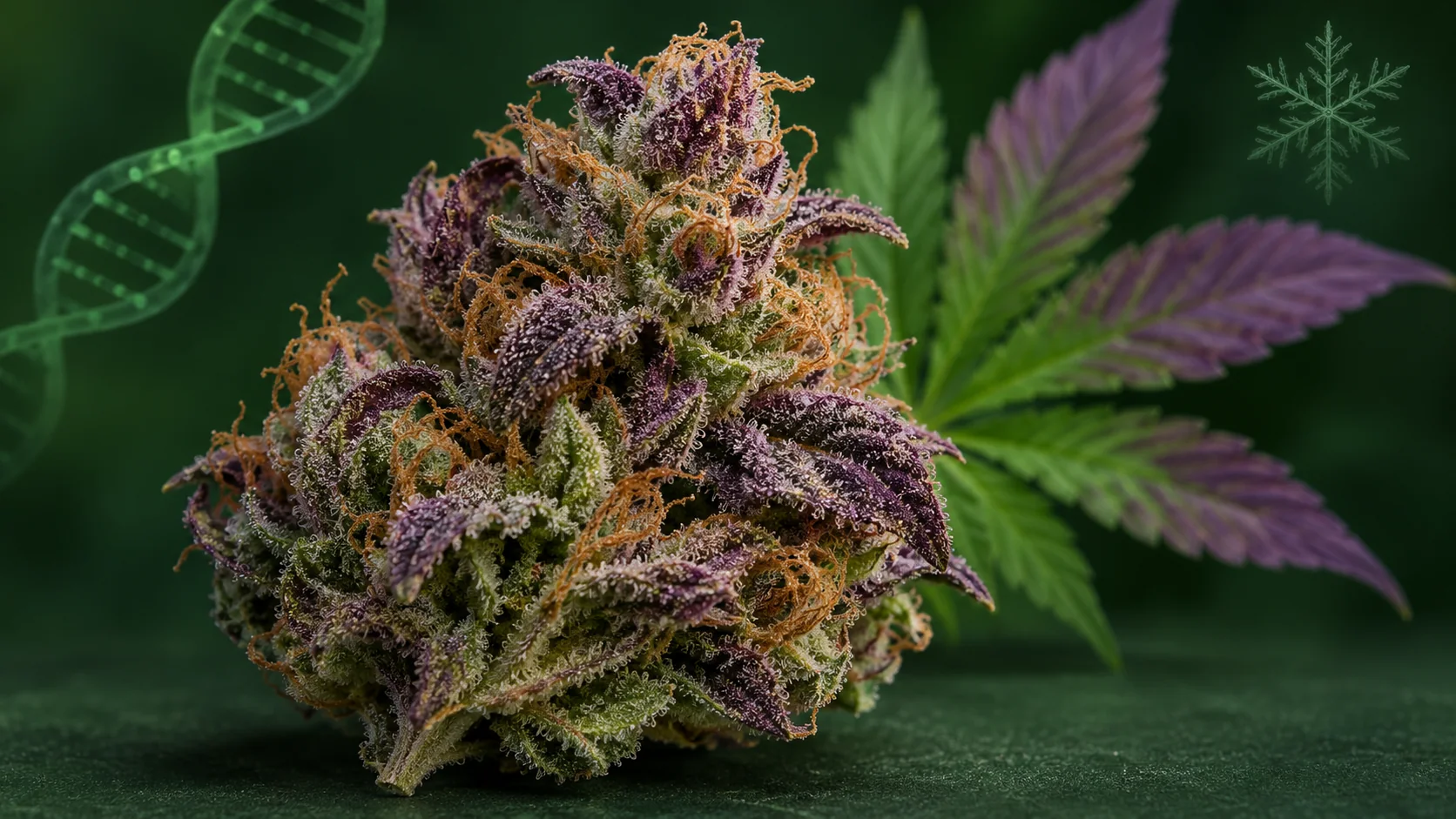
A jar of violet flower is hard to ignore. Deep plum bracts, green edges, orange stigmas, and a layer of pale trichomes can make one bud look dramatically different from the next. That visual contrast also invites a pile of assumptions: purple must mean a particular strain, cold must have created it, and darker flower must be stronger.
Color is useful visual evidence, but those conclusions go too far. To read purple cannabis accurately, separate three layers: the pigments a plant can make, the conditions under which it expresses them, and the unrelated traits—such as cannabinoid content—that only proper records or testing can establish.
Why is weed purple?
Purple cannabis contains visible concentrations of anthocyanins, a family of water-soluble flavonoid pigments found across the plant kingdom. They can contribute red, magenta, purple, and blue tones depending on the exact molecule, its concentration, its cellular surroundings, and other pigments in the tissue.
In cannabis, researchers have identified cyanidin-3-rutinoside—also called keracyanin—as a major anthocyanin in purple leaves, stems, and flowers. Other cyanidin- and peonidin-based compounds have also been detected. These pigments are made through a regulated biochemical pathway and stored inside plant-cell vacuoles.
Anthocyanins are different from chlorophyll, the green pigment central to photosynthesis. A purple flower has not necessarily “lost all its green.” Purple can appear where anthocyanins accumulate over a background that still contains chlorophyll, producing mixed green, burgundy, or nearly black-looking areas.
Genetics sets the color potential
A plant needs the genetic machinery and regulatory signals to produce and accumulate noticeable anthocyanins. Research comparing colorful cannabis varieties has linked expression of multiple anthocyanin-pathway genes with pigment accumulation. In practical terms, that means some cultivars are predisposed to show purple readily while others may remain mostly green under similar conditions.
Genetic potential does not guarantee one perfectly uniform color. Seed siblings can inherit different combinations of traits, and even a clone can express color differently as its environment and development change. Purple may be concentrated in leaves, bracts, petioles, or stems rather than covering an entire plant.
This is a good example of genotype versus phenotype: genes shape what is possible, while the visible plant is the result of genetics interacting with its growing environment.
Does cold weather turn cannabis purple?
Cool temperatures can encourage anthocyanin accumulation in genetically capable cannabis, but “cold makes any weed purple” is a myth. A 2025 controlled study used a purple-pigmented, day-neutral cannabis population and compared temperature treatments. Anthocyanin concentration responded to temperature and peaked in the study's 8°C and 15°C treatments; it was lower at both 0.5°C and 22°C.
That result shows two important things. First, temperature can affect pigment expression. Second, the relationship is not simply “colder equals more purple.” Extreme cold can damage plant function, reduce growth, and create stress without producing attractive or uniform pigmentation. The result from one population and one experiment also should not be treated as a universal recipe for every cultivar.
Light exposure, nutrient status, tissue type, maturity, and other environmental signals may influence anthocyanin pathways too. The scientifically careful version is: genetics provides the capacity, and environment helps shape the expression.
What purple color can—and cannot—tell you
A clear photo can confirm that purple pigmentation is visible and show where it appears. Pattern matters: pigment may be spread through bracts and sugar leaves, limited to leaf edges, or mixed with green areas. That makes color a legitimate visual feature for comparing flower.
Color alone cannot establish:
- Strain identity. Many unrelated cultivars can express similar purple tones, and the same named cultivar can vary across growers and harvests.
- THC or CBD content. Anthocyanins are flavonoid pigments, not a visual measurement of cannabinoids. Potency requires representative laboratory testing.
- Effects. A purple appearance does not guarantee sedation, stimulation, flavor, or a particular experience.
- Terpene profile. Color cannot tell you whether the dominant aroma compounds are fruity, floral, earthy, or fuel-like.
- Overall quality. Attractive pigment can occur in flower that is fresh or stale, well cured or poorly handled.
One temperature study also found that anthocyanin accumulation and total CBD had different responses to temperature. That is a useful reminder that pigment production and cannabinoid production are distinct biological traits—not two views of the same measurement.
Purple pigment vs warning signs
Healthy purple pigmentation usually looks like color within plant tissue. It follows the surface of bracts or leaves rather than sitting on top as a separate fuzzy growth. Trichomes may sparkle over both green and purple areas.
Be more cautious when discoloration comes with:
- white, gray, or web-like fuzz;
- powdery patches that look separate from normal resin glands;
- soft, damp, collapsing, or unusually dark tissue;
- an ammonia-like, musty, or basement odor; or
- unexpected internal browning when a dense flower is opened.
Those signs are not “extra purple.” They can point to damage, decay, or microbial growth. A photograph may reveal a reason for caution, but it cannot rule contamination in or out. If flower appears moldy, avoid using it; see the moldy weed vs trichomes guide for a closer visual comparison.
Why purple weed looks different in photos
Cameras do not record color neutrally. Warm indoor bulbs can turn violet toward brown or red. Cool LEDs can exaggerate blue. Automatic white balance, exposure, HDR processing, saturation, and a colorful background can all alter what a viewer sees.
For a more useful identification photo:
- Use neutral light. Indirect daylight or a high-quality white lamp is better than colored grow lights.
- Include green and purple areas. The contrast helps a viewer or image tool interpret the hue.
- Avoid filters. Do not increase saturation, contrast, or “vivid” color before scanning.
- Set a plain background. White, gray, or matte black reduces color spill and visual distraction.
- Keep the flower sharp. Stabilize the phone, tap to focus, and fill the frame without digital zoom.
The same steps improve any weed identification photo, because a tool can only compare the information the camera actually captured.
Can purple help a weed strain identifier?
Yes—as one feature among many. A visual identifier can compare color distribution alongside bud structure, leaf remnants, trichome appearance, pistils, density, and overall shape. Purple may narrow resemblance within a supported reference catalog, especially when the photo is color-accurate.
It still cannot turn a shared pigment into proof of lineage. Many plants use the same anthocyanin pathway, and photos contain no breeder records, DNA profile, or chemical analysis. Treat a photo match as a visual lead, then check packaging, producer and batch information when provenance matters.
Scan the visible clues
KushScan compares a clear cannabis flower photo with supported visual references. Use color as one clue—not as proof of strain, potency, chemistry, or safety.
Download KushScanThe takeaway
Purple weed gets its color mainly from anthocyanin pigments. Genetics determines whether a plant has strong purple potential, while temperature, development, light, and other conditions influence how that potential appears. The color is real and useful for describing a flower, but it does not prove the strain or reveal THC, CBD, terpenes, effects, or quality. Read purple as a phenotype—one visible trait in a much larger picture.
Sources
- Plants: When Cannabis sativa L. Turns Purple—Biosynthesis and Accumulation of Anthocyanins, biochemical identification of anthocyanins in purple cannabis tissues.
- Plant Direct: Leaf Pigmentation—Characterization of Anthocyanin Biosynthesis in Colorful Cannabis Varieties, research on metabolites and gene expression associated with cannabis pigmentation.
- BMC Plant Biology: Anthocyanin Accumulation, Inflorescence Dry Weight and Total Cannabidiol Content Have Different Temperature Optima in Cannabis sativa, controlled temperature research on purple pigmentation, yield, and CBD.