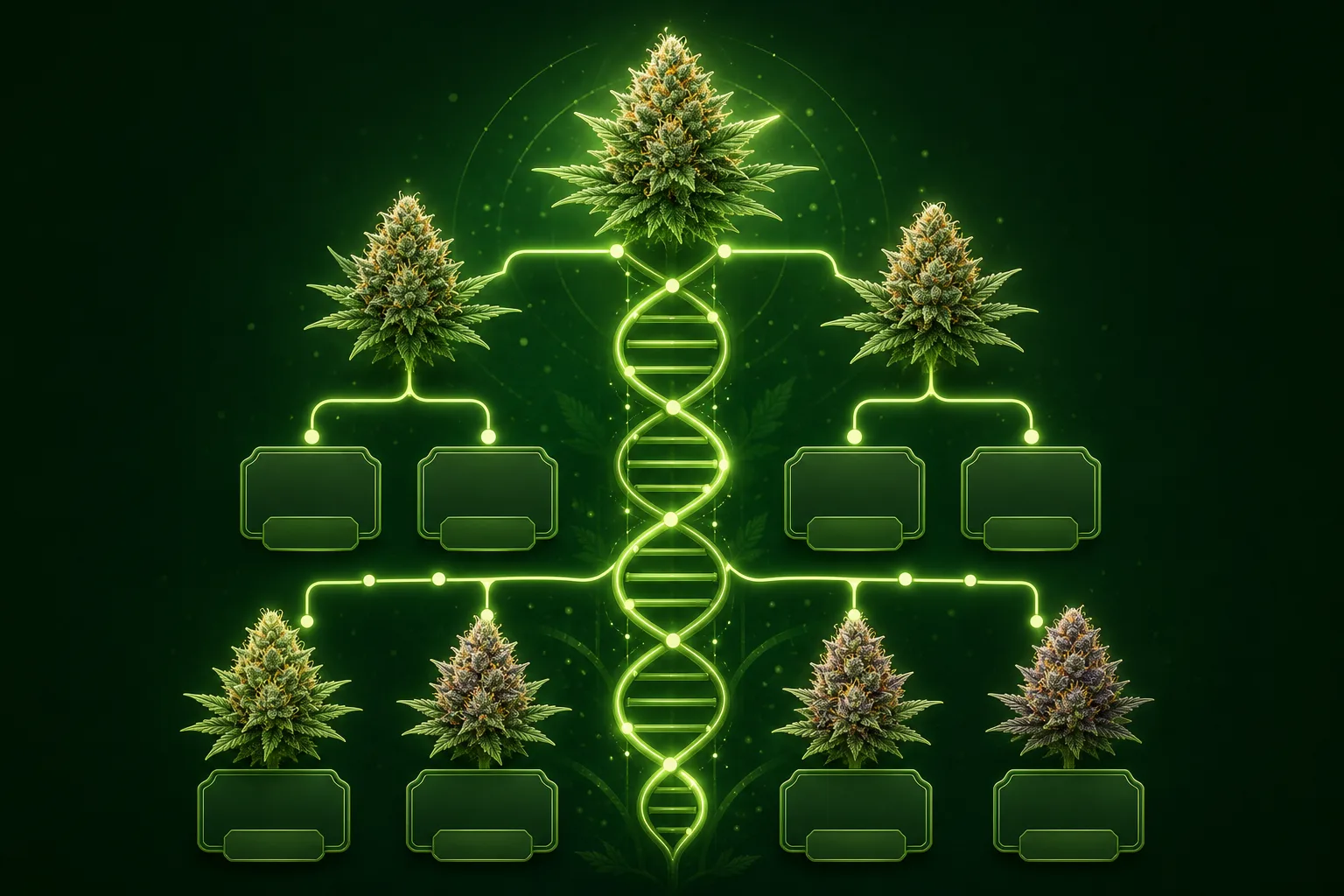
Strain names are the pop culture layer of cannabis. Blue Dream, OG Kush, Sour Diesel, Gelato, Runtz, Wedding Cake, Northern Lights — names help people remember what they liked and ask for something similar next time. But the plant biology underneath those names is more nuanced than most menus suggest.
This guide explains cannabis genetics for beginners without pretending every jar can be solved by a family tree. You will learn what genotype, phenotype, cultivar, chemovar, lineage, and “indica vs sativa” really mean — and how to use those clues when comparing flower, labels, COAs, and photo-based strain identification.
Cannabis genetics explained in plain English
Cannabis genetics are the inherited traits a plant can pass down: growth pattern, resin production potential, cannabinoid tendencies, terpene production, flowering behavior, bud structure, color expression, disease resistance, and more. Think of genetics as the plant’s possibility map.
That possibility map does not act alone. A grower’s choices — lighting, nutrients, temperature, humidity, harvest timing, drying, curing, and storage — shape how the genetics show up in the final flower. The same seed line grown in different rooms can produce noticeably different buds.
In other words: genetics set the range. The environment, grow skill, harvest, and post-harvest handling decide where the final flower lands inside that range.
Genotype vs phenotype: the easiest way to understand variation
Two words explain a lot of cannabis confusion:
- Genotype: the plant’s underlying genetic code — the inherited instructions.
- Phenotype: the visible and measurable expression of those instructions in a specific plant and environment.
If a breeder pops ten seeds from the same cross, those plants can be siblings rather than clones. One may lean taller, one may show denser buds, one may smell fruitier, one may produce more purple color under certain conditions, and one may test with a slightly different cannabinoid or terpene profile. Those are phenotype differences.
This is why growers “hunt” phenotypes. They look for the best expression of a cross, then preserve it with clones or further breeding. When consumers hear that a strain has a famous “cut,” it often means a particular selected plant became known for a reliable look, smell, or experience.
Strain, cultivar, chemovar: three labels for three different ideas
People usually say “strain,” but cannabis professionals often use more precise terms:
- Strain: the common consumer word for a named cannabis type. Useful, familiar, but not always scientifically strict.
- Cultivar: a cultivated variety selected or maintained by humans. This is often the cleaner horticultural word.
- Chemovar: a chemical variety, meaning the plant is grouped by its chemistry — cannabinoids, terpenes, and other measurable compounds.
For shopping and strain culture, “strain” is fine. For understanding effects and product consistency, chemovar thinking is often stronger. A lab report showing THC, THCA, CBD, minor cannabinoids, and terpenes may tell you more about the actual flower than the name alone.
Why lineage matters — and why it is not everything
Lineage is the family story: which parents, grandparents, or known crosses helped create a strain. It can explain why Gelato may share dessert-like traits with other Cookies-family strains, why Sour Diesel is associated with sharp fuel notes, or why OG Kush descendants often carry dense, resinous, gassy expectations.
Lineage is useful because inherited traits can cluster. If you loved several strains from the same family, you may enjoy related genetics. If a strain repeatedly gives you the flavor profile you want, parentage can point you toward similar flower.
But lineage has limits:
- Names are not always standardized across producers or regions.
- Different phenotypes of the same cross can express differently.
- Clones, seed lines, renamed cuts, and marketing names can blur the family tree.
- Lab-tested chemistry may differ from what the name implies.
- Storage and age can flatten aroma even when the genetics are excellent.
The smartest approach is to treat lineage as a clue, then confirm with visible quality, aroma, package dates, COAs, and your own history with similar products.
The indica/sativa shortcut is older than today’s market
Many people still use indica, sativa, and hybrid as quick effect labels: indica for relaxing, sativa for energizing, hybrid for somewhere between. The problem is that modern cannabis has been crossed heavily for decades. A simple label rarely captures genetic ancestry, chemistry, or consumer experience.
Research has found that marijuana and hemp can be genetically differentiated, but consumer strain labels and ancestry categories are not always as clean as dispensary shelves imply. Scientific Reviews in Nature also describes large variation within identically named strains and notes that “strain” itself lacks a clear universal definition in the market.
That does not mean indica/sativa labels are useless. They can still be part of how a brand communicates expectations. Just do not treat them like a lab result. Cannabinoids, terpenes, dose, tolerance, setting, and product form all matter.
How genetics shape what you can see in a bud photo
A clear flower photo cannot reveal a full genome. It cannot prove THC percentage, terpene content, pesticide safety, or exact identity. But genetics and phenotype can influence visual traits that a trained eye — or a visual tool like KushScan — can compare:
- Bud structure: dense, chunky, spear-shaped, airy, foxtailed, compact, or loose.
- Color expression: greens, orange pistils, purple anthocyanin expression, pale or darker tones.
- Resin appearance: visible trichome coverage, sparkle, frostiness, and surface texture.
- Trim and handling: not genetic by itself, but important for quality comparison.
- Family resemblance: some related strains share recognizable structure, color, or surface traits.
That is where photo-based identification is strongest: pattern comparison and education, not absolute proof. For the bigger picture, see our guide on how to identify a weed strain by picture and our practical tips for taking better weed photos.
How to use cannabis genetics as a consumer
You do not need to become a breeder to make better choices. Use cannabis genetics as a map, then add real-world evidence:
- Track what works for you: keep notes on strain name, producer, batch, THC/CBD numbers, terpenes, dose, and your experience.
- Look for families, not just single names: if you like Blue Dream, OG Kush, Gelato, or Sour Diesel, explore related strains thoughtfully.
- Check the producer: the same name from two growers may not be the same experience.
- Read the COA when available: chemistry helps ground the marketing name.
- Respect freshness: great genetics can still disappoint if the flower is old, dry, poorly cured, or badly stored.
- Compare photos honestly: visual similarity is helpful, but not a replacement for labels or lab testing.
If you are comparing popular names, our guide to the top popular weed strains in the US shows why famous names keep circulating — and why context matters. If you want the chemistry side, start with terpenes in weed and THCA vs THC.
Compare flower visually with KushScan
KushScan helps you study dry cannabis flower photos for structure, color, trichome cues, and strain-pattern similarity. Use it alongside strain lineage, labels, COAs, freshness checks, and responsible dosing — not as a replacement for lab testing.
Download KushScanThe takeaway
Cannabis genetics are the family instructions behind a plant, but the final flower is shaped by phenotype, cultivation, harvest timing, drying, curing, storage, chemistry, and naming practices. Strain lineage can guide you toward similar flavors, structures, and experiences, but it should not be treated as proof. The best consumers combine the name, the grower, the COA, the aroma, the bud quality, the photo, and their own notes.
Sources
- PLOS ONE: The Genetic Structure of Marijuana and Hemp, peer-reviewed study using genome-wide markers to examine cannabis population structure and hemp/marijuana differentiation.
- Scientific Reports: Chemometric Analysis of Cannabinoids: Chemotaxonomy and Domestication Syndrome, open-access discussion of strain naming limits, chemical variation, and cannabis domestication.
- Frontiers in Plant Science: Hermaphroditism in Marijuana Inflorescences, peer-reviewed background on cannabis reproduction, sex expression, seed formation, and genetic variation in progeny.
- NIH NCCIH: Cannabis, Marijuana, and Cannabinoids — What You Need To Know, federal overview of cannabis terminology, cannabinoids, and research context.