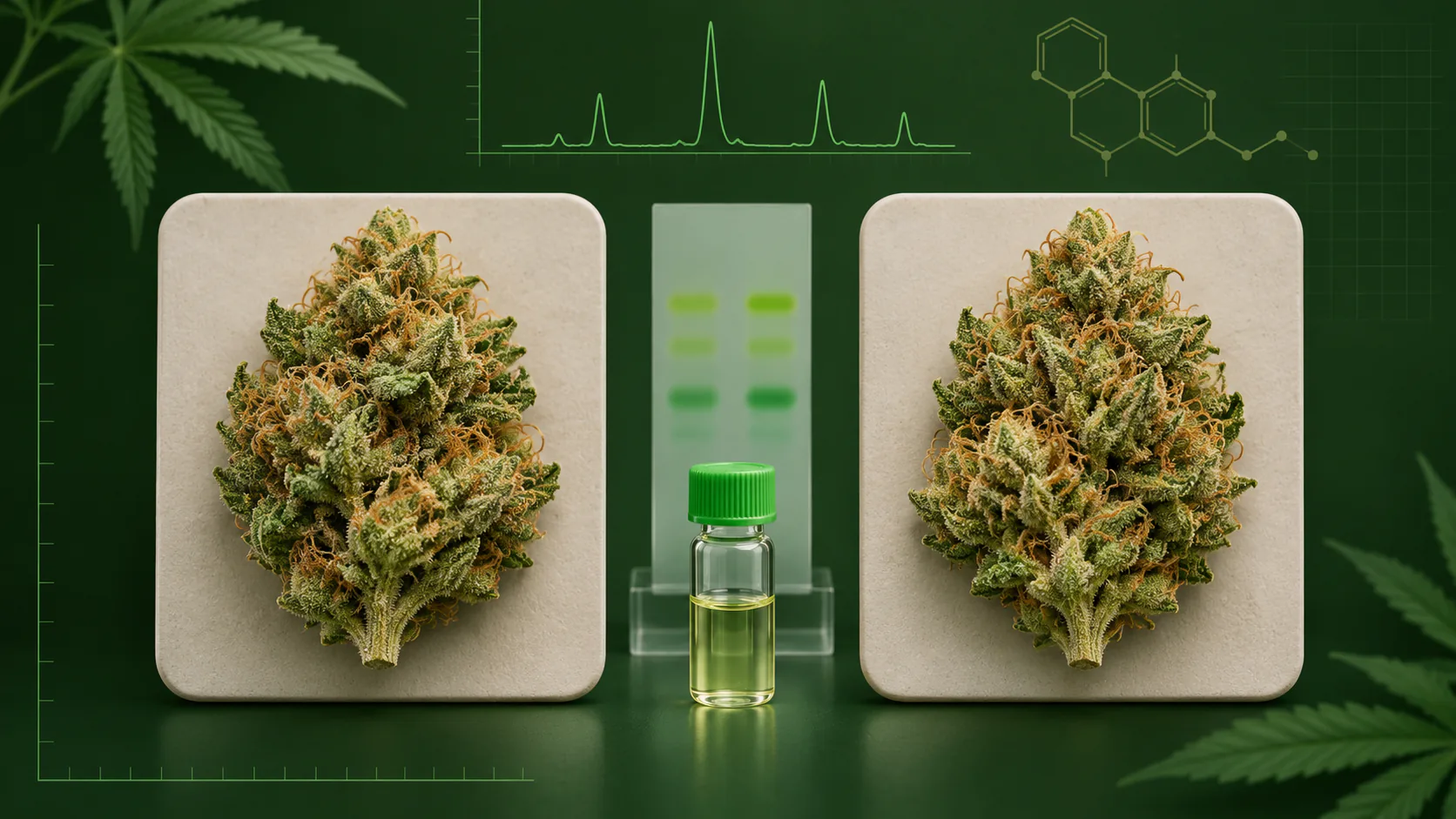
Short answer: no, you cannot reliably tell hemp from marijuana by looking at a plant, bud, or photograph. Some fiber hemp plants are tall and sparsely branched, while some drug-type plants are shorter and produce dense flowers—but modern hemp grown for cannabinoids can look much like high-THC cannabis. Laboratory measurement, supported by trustworthy batch records, is what separates the categories.
This is also why a frosty “hemp” bud is not automatically mislabeled and a modest-looking flower is not automatically low in THC. Resin, pistils, color, density, and trim are visible. Exact cannabinoid concentrations are not.
Hemp vs marijuana appearance at a glance
| Clue | What you may observe | What it cannot prove |
|---|---|---|
| Overall plant shape | Some fiber cultivars grow tall with long internodes; some flower cultivars grow bushier | Whether a particular plant meets a legal THC threshold |
| Flower density | Compact, airy, leafy, or elongated buds | Hemp versus marijuana, potency, or cultivar identity |
| Trichomes | Visible resin glands that may make flower look “frosty” | The amounts of THC, CBD, or other cannabinoids inside them |
| Aroma | Citrus, pine, fruit, fuel, earth, or other volatile compounds | A legal category or cannabinoid percentage |
| Color | Green, purple, orange-brown pistils, pale leaves, or aging tissue | Chemotype, safety, or psychoactive potential |
| Package label | A stated strain, cannabinoid profile, batch, and producer | Accuracy unless the label matches credible testing and traceability records |
Why hemp and marijuana can look identical
Both terms refer to cannabis. They do not describe two plants separated by one unmistakable shape. Breeders and growers have selected cannabis for fiber, seed, cannabinoids, aroma, flower yield, growth habit, and many other traits. The result is a wide range of forms with substantial overlap.
Traditional industrial hemp selected for long fibers often has a tall, narrow habit and is grown at high density. Cannabis selected for flower may be more branched and managed to produce large inflorescences. Those broad production patterns can be useful when viewing an entire field with cultivation context. They break down quickly when you inspect one plant—and almost completely when you inspect one trimmed, dried bud.
CBD-rich smokable hemp makes the old silhouette shortcut especially unreliable. It may be bred, harvested, dried, and trimmed for aromatic flower rather than stalk fiber. Its visible bracts, stigmas, sugar leaves, and glandular trichomes are the same basic structures described in our cannabis flower anatomy guide.
The real difference is measured chemistry
In U.S. federal law, hemp is a legal classification based on statutory cannabinoid limits and other conditions—not a visual species test. As of this article’s November 4, 2026 publication date, federal rules are in transition: legislation enacted in 2025 changes the federal hemp definition effective November 12, 2026, including a shift toward total THC and additional product exclusions. State definitions and rules can differ. This article is educational, not legal advice; check current federal and state requirements for a real product or crop.
For regulated hemp production, the U.S. Department of Agriculture requires laboratory methods that account for the potential conversion of THCA to delta-9 THC. Labs grind the sample to improve homogeneity, use validated analytical methods, and report measurement uncertainty. None of those steps can be reproduced by viewing a phone photo.
This chemistry-first distinction matters because most cannabinoid acids in fresh and carefully dried flower include THCA and CBDA. Heat can convert those acidic cannabinoids into THC and CBD through decarboxylation. A method that measures only what looks shiny or smells strong would miss the actual legal test.
Can trichomes reveal hemp vs marijuana appearance?
No. Glandular trichomes are the tiny resin-producing structures on cannabis flowers. High-THC plants can be heavily frosted, but CBD-dominant hemp flower can also carry abundant trichomes. A macro image may reveal intact or damaged resin heads; it cannot reveal which cannabinoids dominate or their percentages.
Even color is a poor proxy. Trichome appearance changes with magnification, lighting, maturity, handling, and camera processing. Read our guide to what frosty weed can and cannot tell you before treating sparkle as a potency meter.
What about smell?
Aroma does not solve the problem. Hemp and high-THC cannabis can share terpenes and other volatile compounds, producing overlapping citrus, pine, floral, earthy, skunky, or fuel-like notes. Smell may offer clues about freshness, storage, and broad aroma families, but it does not directly measure THC.
A strong aroma is not proof that flower is intoxicating, just as a mild aroma is not proof that it is hemp. Drying, curing, age, temperature, packaging, and nose-to-nose differences all affect the experience. Our cannabis aroma identification guide explains those limits in more detail.
Why field tests and lab tests are different
Some field methods can indicate that a material is cannabis or that a target compound may be present. That is not the same as accurately quantifying cannabinoids near a legal decision point. The National Institute of Standards and Technology has worked on reference materials and interlaboratory studies precisely because reliable differentiation requires accurate chemical measurement.
NIST-backed forensic guidance states that an identification-only analytical scheme without a quantitative decision point cannot differentiate hemp from marijuana. In plain English: even confirming “this is cannabis” does not answer “which legal category is it?”
A defensible result depends on more than an instrument reading. Sampling matters because cannabinoid levels vary across a plant or lot. Sample preparation, calibration, method validation, uncertainty, chain of custody, and the rule used by the relevant jurisdiction all matter too.
Can an AI photo tool identify hemp?
An image model can compare visible patterns: flower structure, color distribution, pistils, leaf fragments, resin coverage, trim, and condition. It may find visually similar examples or flag that an image looks like cannabis flower. It cannot see molecules or calculate a compliant cannabinoid concentration from pixels.
That means a responsible photo result should be treated as visual classification, not chemical authentication. The same principle applies to strain names. A picture can suggest similarity to examples in a catalog, but it cannot prove genetics, breeder provenance, or a lab profile. See how accurate weed strain identifier apps are for a practical explanation.
How to verify a hemp or marijuana label
- Match the batch. The lot or batch number on the package should match the certificate of analysis, not merely the product name.
- Check the laboratory and dates. Look for a named lab, sample or test date, and a report that can be independently retrieved when possible.
- Read the cannabinoid panel carefully. Do not confuse THCA with delta-9 THC or ignore the total-THC calculation used by the applicable rule.
- Confirm the jurisdiction. Federal production rules, state cannabis programs, and rules for finished hemp-derived products are not interchangeable.
- Use appearance for condition, not legal status. Photos can help document mold-like growth, damage, unusual color, or poor storage, but they do not replace compliance testing.
If you have a report, our guide to reading a cannabis COA can help you connect the batch, potency panel, terpene results, and safety screens.
What a picture can tell you instead
- whether the subject resembles a live cannabis plant or cured cannabis flower;
- visible flower architecture, trim style, pistils, trichome coverage, and leaf material;
- possible dryness, compression, age, discoloration, or contamination cues;
- whether the image is sharp, evenly lit, and useful for visual comparison; and
- which catalog examples share similar visible features.
Those observations can be useful without pretending they answer a chemistry question. If flower looks suspicious, do not rely on a photo to establish safety. Avoid using it until a qualified source can evaluate it.
Use KushScan for visual matching—not chemical proof
KushScan compares a clear dry-flower photo with examples in its supported strain catalog. Use the result to explore visible similarities and possible matches. Verify hemp status, potency, and safety with batch records and appropriate laboratory testing.
Download KushScanThe takeaway
Hemp vs marijuana appearance is not a dependable distinction. Whole-plant architecture may hint at how a crop was bred and cultivated, but modern cannabinoid hemp and high-THC flower can look remarkably alike after harvest. Trichomes, aroma, color, and density do not reveal a legal cannabinoid threshold. Use photos for visual description and comparison; use credible, jurisdiction-appropriate laboratory results for chemistry.
Sources
- USDA Agricultural Marketing Service: Laboratory Testing Guidelines for the U.S. Domestic Hemp Production Program, official guidance on total-THC testing, sample preparation, validated methods, and measurement uncertainty.
- National Institute of Standards and Technology: Study Will Help Labs Distinguish Between Hemp and Marijuana, an overview of the analytical challenge and the need for accurate measurement.
- NIST/OSAC: Building an Analytical Scheme for the Assessment of THC in Suspected Marijuana Plant Material Samples, forensic guidance explaining why identification without quantitative analysis cannot distinguish the categories.
- Congressional Research Service: Changes to the Statutory Definition of Hemp and Issues for Congress, current summary of the 2025 amendment and its November 12, 2026 effective date.
- Plants: The Past, Present and Future of Cannabis sativa Tissue Culture, peer-reviewed discussion noting that cannabinoid hemp can morphologically resemble drug-type cannabis.
- PLOS ONE: Broad-Scale Genetic Diversity of Cannabis for Forensic Applications, peer-reviewed research on cannabis genetic groups and chemical phenotypes.