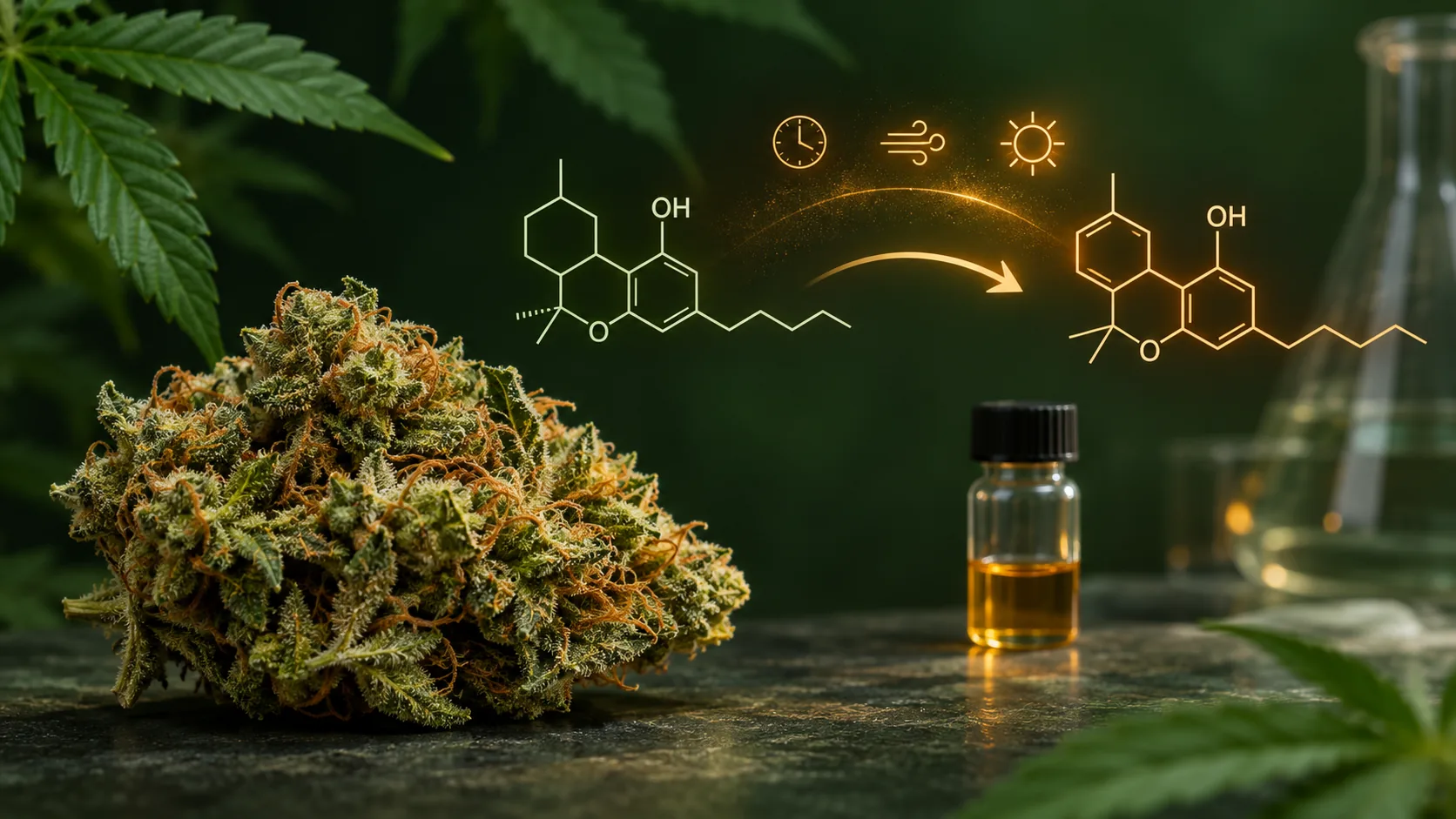
Short answer: CBN is a cannabinoid found in cannabis, usually in small amounts. Unlike THC and CBD, it is not produced mainly through a dedicated pathway in fresh flower. Much of it appears as THC changes through oxidation and other reactions during storage and processing. That makes CBN useful to study—but it does not turn every old jar of cannabis into a predictable sleep product.
What is CBN in cannabis?
Cannabinol is one of the many compounds grouped under the term cannabinoids. Fresh cannabis primarily builds cannabinoid acids such as THCA and CBDA. Heat and time can remove carbon dioxide from these acids in a process called decarboxylation, forming neutral THC and CBD.
CBN follows a different story. Scientific reviews describe it largely as an oxidative degradation product of delta-9 THC. Over time, light, oxygen, heat, and storage conditions can change the chemistry of a sample, with some THC-related material eventually becoming CBN and other products.
This is why older cannabis may contain more CBN than a fresher version of the same material. The word may matters: starting chemistry, temperature, light exposure, air, packaging, time, and laboratory method all affect the result.
Does CBN mean cannabis is old?
An increased CBN result can be consistent with THC degradation, but it is not a precise expiration clock. A lab cannot look at one CBN number and reliably tell you the harvest date, how the flower was stored, or how much THC was present at the beginning.
- Low CBN does not prove freshness. A sample might have started with little THC, been stored well, or degraded along other chemical paths.
- Higher CBN does not prove unsafe flower. It says something about chemistry, not whether microbes, pesticides, heavy metals, or other contaminants are present.
- Appearance cannot measure the change. Brown color, dryness, or faded aroma can suggest poor storage, but only laboratory testing can quantify cannabinoids.
If preserving flower quality is the goal, use an airtight container in a cool, dark, dry place and avoid repeated heat and light exposure. See our practical guide to storing cannabis for more detail.
Is CBN intoxicating?
CBN interacts with the endocannabinoid system, including cannabinoid receptors, but reviews report lower CB1 receptor affinity and activity than delta-9 THC. That does not justify calling every dose “non-intoxicating” or impairment-free. Human dose-response, repeated-use, and interaction data remain limited, and retail products may also contain THC.
The cautious rule is to judge the complete product—not the headline ingredient. Check the cannabinoid panel, use extra care when combining it with alcohol or sedating medicines, and do not drive or operate machinery until you know how the product affects you.
Does CBN help with sleep?
Sleep is the biggest claim attached to CBN, but marketing moved faster than controlled research. A 2021 evidence review found insufficient published clinical evidence for a CBN sleep claim at that time. More human trials have since appeared, but they do not yet make CBN an established insomnia treatment.
A 2024 decentralized, randomized trial compared nightly hemp-derived CBN doses of 25, 50, or 100 mg with placebo and a 4 mg melatonin group. Participants using each CBN formulation reported improved sleep-disturbance scores compared with placebo. The study was large, but it relied on self-reported outcomes, studied branded formulations rather than every CBN product, and disclosed commercial involvement. It is evidence worth following, not proof that any store-bought CBN gummy treats insomnia.
A separate 2026 randomized crossover trial tested single 30 mg and 300 mg CBN doses in just 20 adults with diagnosed insomnia using overnight laboratory measurements. Neither dose significantly improved the primary outcome—wake time after sleep onset—versus placebo. The 300 mg dose improved some secondary measures, including sleep-onset latency, while the lower dose did not. The authors said the study did not directly establish effectiveness in routine clinical care.
Together, these trials show why “CBN works” and “CBN does nothing” are both too simple. Formulation, dose, study population, treatment duration, and outcome measure differ. Larger independent trials with repeated dosing and objective sleep measures are still needed.
Is CBN FDA-approved?
No CBN product is FDA-approved to diagnose, treat, cure, or prevent insomnia or another disease. FDA currently lists one approved cannabis-derived drug containing purified CBD and three approved synthetic cannabis-related medicines for specific prescription uses. That approval history does not extend to CBN oils, gummies, capsules, flower, or cosmetics.
A product can be available for sale without having demonstrated the quality, safety, and effectiveness required for an approved medicine. Avoid treating package claims, influencer testimonials, or the word “natural” as clinical evidence.
How to read a CBN product label
- Find the amount per serving. A large number on the front may describe the entire package.
- Check for THC and other cannabinoids. “CBN product” does not mean CBN-only.
- Match the lot to the COA. The batch number on the product should match the laboratory report.
- Review the test date and methods. A current, batch-specific report is more useful than a generic example.
- Look beyond potency. Depending on the product and jurisdiction, useful panels may include pesticides, solvents, heavy metals, microbes, and mycotoxins.
- Question disease and guaranteed-sleep claims. A cannabinoid amount is not a promise of a particular effect.
Our guide to reading a cannabis COA explains how to verify the batch and interpret potency and safety sections.
Can a photo identify CBN-rich cannabis?
No. CBN is a molecule, not a visible feature. A photo may reveal color, flower structure, trim, trichome coverage, dryness, or signs that deserve a closer look. It cannot measure CBN, THC, freshness, contaminants, or sedating effects.
Even if an image looks old or oxidized, appearance cannot separate CBN from the many other chemical and physical changes that occur during storage. A batch-matched laboratory test is the appropriate tool for cannabinoid content.
Use photos for visible comparisons
KushScan compares a clear dry-flower photo with examples in its supported strain catalog. It can help you explore visible similarities, but it cannot measure CBN, authenticate age, predict sleep effects, or replace a laboratory report.
Download KushScanThe takeaway
CBN is a minor cannabinoid closely tied to the oxidation and degradation of THC. Its presence can provide chemical context about a sample, but it is not a reliable clock and cannot be seen in a photo. Early human sleep trials offer interesting but mixed findings, and no CBN product is FDA-approved as a sleep medicine. Read the full label, match the batch to its COA, and treat confident health promises with caution.
Sources
- Pharmacological Reviews: Minor Cannabinoids—Biosynthesis, Molecular Pharmacology and Potential Therapeutic Uses, peer-reviewed review of CBN formation and receptor pharmacology.
- Cannabis and Cannabinoid Research: Cannabinol and Sleep—Separating Fact from Fiction, evidence review of historical sleep claims and research gaps.
- Pharmaceuticals: Randomized Trial of Hemp-Derived CBN Formulations for Sleep, 2024 placebo-controlled study of self-reported sleep outcomes.
- Journal of Sleep Research: Cannabinol for Acute Treatment of Insomnia Disorder, 2026 randomized crossover trial using objective overnight sleep measures.
- FDA: Cannabis Research and Drug Approval Process, federal context for approved cannabis-derived and cannabis-related medicines.